AI & Technology
Tavus AI: What It Is, How It Works, and Why It Matters
What is Tavus AI?
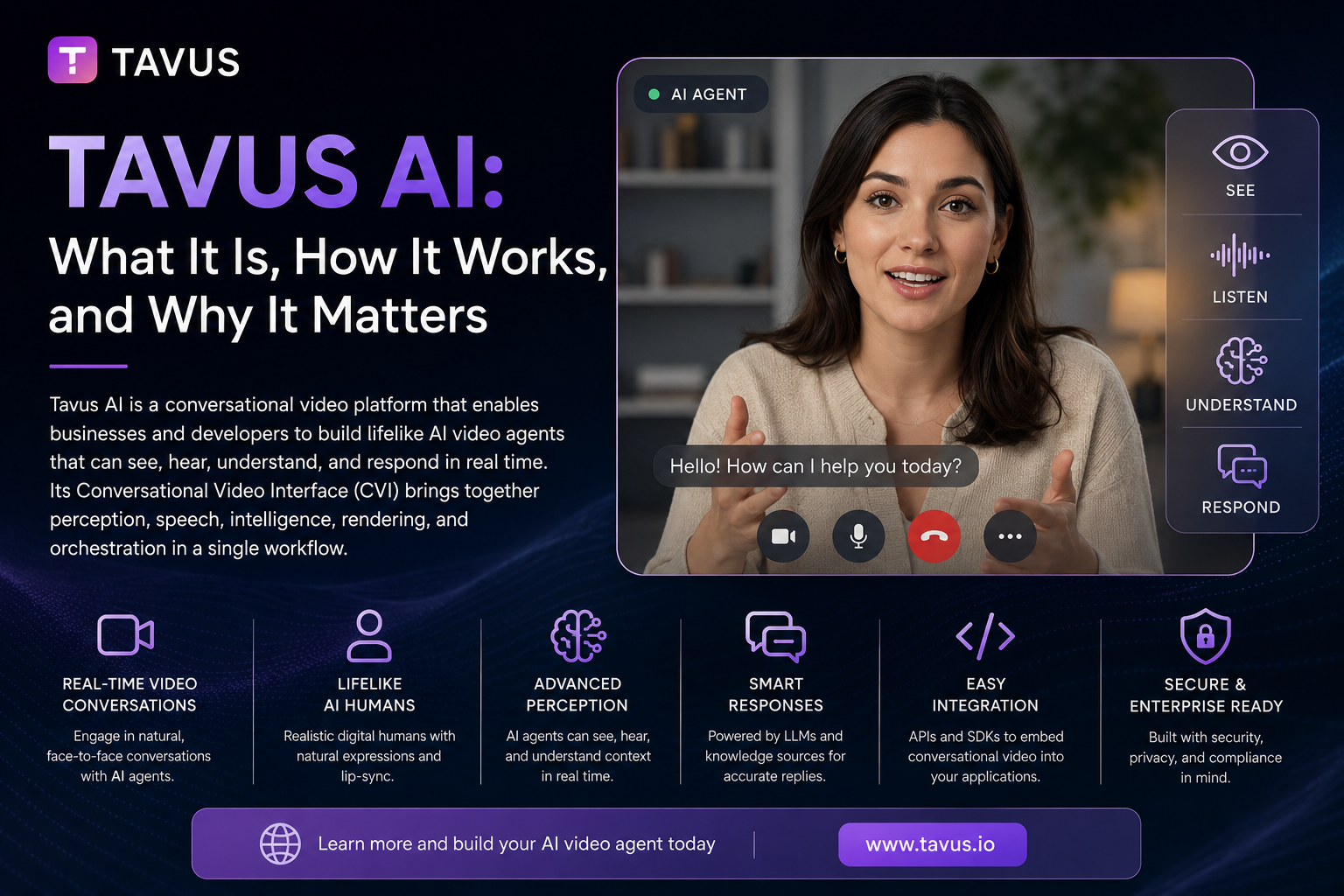
Tavus AI is a platform for building real-time conversational video experiences. Instead of using a traditional chatbot that communicates only through text or a static avatar that plays predefined responses, Tavus enables AI video agents to see, hear, understand, and respond during live conversations. Its Conversational Video Interface (CVI) brings together speech, perception, language intelligence, video rendering, and conversation orchestration.
When Was Tavus AI Introduced?
Tavus began developing AI video technology around digital replicas and video generation before expanding into real-time conversational experiences. In 2024, Tavus introduced its Conversational Video Interface, allowing developers to build interactive experiences with digital twins that could speak, see, and hear. The platform has since expanded toward AI humans and enterprise video agents.
- 2024: Tavus introduced its Conversational Video Interface for developers.
- Conversational Video: The platform moved beyond prerecorded AI videos toward real-time, two-way interactions.
- AI Humans: Tavus developed lifelike digital interfaces designed to interact with users face-to-face.
- Video Agents: Businesses can use AI video agents for workflows such as sales, recruiting, education, and customer interactions.
- Current Platform: Tavus provides APIs and tools for embedding conversational video into products and business workflows.
How Does Tavus AI Work?
Tavus combines several AI capabilities into a real-time conversational pipeline. The system can process what a person says and, depending on the experience, interpret visual and contextual signals before generating a response. The response is then rendered through a lifelike digital human so the interaction feels closer to a video conversation than a traditional chatbot.
- User Input: A person interacts with the AI through a live video conversation.
- Perception: Tavus models can interpret speech, facial cues, body language, and environmental context.
- Conversation Intelligence: An LLM and configured persona determine what the AI should say or do next.
- Turn-Taking: The system manages when the AI should listen, pause, and respond to make conversations feel natural.
- Video Rendering: Tavus generates the AI human's facial expressions, lip movements, and other visual behavior in real time.
- Final Response: The user receives a spoken and visual response during the live conversation.
How to Use Tavus AI
- Step 1 - Create a Tavus Account: Sign up for the Tavus platform and access the developer or AI video tools.
- Step 2 - Create an AI Persona: Define the personality, behavior, tone, objectives, and knowledge of your AI agent.
- Step 3 - Choose or Create a Replica: Select a digital human or create a custom replica that represents your AI persona.
- Step 4 - Add Knowledge: Connect relevant documents, knowledge sources, or retrieval systems so the AI can provide grounded responses.
- Step 5 - Configure the Conversation: Define the instructions, objectives, guardrails, and functions the AI should use.
- Step 6 - Integrate CVI: Use Tavus APIs or supported components to embed the conversational video experience into your application.
- Step 7 - Test and Improve: Test conversations and refine the persona, knowledge, objectives, and behavior.
What Can You Do With Tavus AI?
- AI Video Agents: Build AI agents that communicate with users through real-time video.
- Digital Humans: Create lifelike AI characters that represent a company, product, or service.
- AI Sales Agents: Use conversational video agents for lead qualification, product conversations, and sales workflows.
- AI Recruiters: Conduct candidate screening conversations and collect structured information.
- Education and Training: Create interactive AI coaches and practice environments.
- Customer Support: Provide face-to-face AI assistance instead of relying only on text-based support.
- Research: Conduct conversational interviews and collect information through interactive AI agents.
- Product Experiences: Embed AI humans directly inside websites and applications.
Why Should You Use Tavus AI?
The main advantage of Tavus is that it focuses on real-time human-like interaction rather than simply generating prerecorded AI videos. The platform combines visual presence, conversation intelligence, perception, and real-time rendering into a single experience.
- Real-Time Interaction: Users can have live two-way conversations with AI video agents.
- Human-Like Presence: AI agents can communicate through a realistic digital face rather than text alone.
- Multimodal Understanding: The platform is designed to process spoken and visual information during conversations.
- Custom Personas: Businesses can configure AI agents with specific personalities, knowledge, goals, and behavior.
- Knowledge Integration: Tavus supports knowledge retrieval so agents can use business-specific information.
- Developer Integration: APIs and components allow businesses to embed conversational video into their own products.
Tavus AI vs Traditional AI Chatbots
Traditional AI chatbots generally communicate through text, while voice assistants primarily rely on audio. Tavus takes the interaction further by adding a real-time visual interface in which an AI human can see, hear, and respond to the user.
- Traditional Chatbot: Primarily communicates through text.
- Voice Assistant: Communicates through spoken audio but has limited visual presence.
- Static AI Avatar: Usually displays a predefined or scripted digital character.
- Tavus AI: Provides a real-time conversational video experience with a responsive digital human.
- Key Difference: Tavus combines perception, conversation intelligence, turn-taking, and real-time facial rendering into one interface.
What Makes Tavus AI Different?
One of the most important ideas behind Tavus is the Conversational Video Interface, or CVI. Instead of treating video as a simple presentation layer, Tavus uses it as an interface through which people can interact with AI. The platform combines specialized capabilities for perception, conversational timing, intelligence, and realistic rendering.
- Conversational Video Interface: CVI brings real-time video conversation into applications.
- Perception: Tavus models can interpret visual and conversational context.
- Turn-Taking: Specialized models help the AI determine when to listen and respond.
- Realistic Rendering: Phoenix models generate facial movement, expressions, and lip synchronization.
- AI Personas: Businesses can configure the agent's personality, knowledge, behavior, and objectives.
- Knowledge Base: Business documents and other sources can be used to ground AI responses.
Tavus AI for Businesses
Tavus can be particularly useful for businesses where communication, trust, and human interaction are important. Instead of replacing every conversation with a traditional chatbot, companies can use AI video agents for specific workflows that require explanation, questioning, qualification, coaching, or personalized interaction.
- Sales: Use AI video agents to qualify leads and explain products or services.
- Recruiting: Conduct initial candidate conversations and structured interviews.
- Education: Create interactive tutors, instructors, and training coaches.
- Healthcare: Build conversational intake and information-gathering experiences where appropriate.
- Customer Support: Provide personalized video-based assistance.
- Research: Conduct structured interviews and conversational research.
- Onboarding: Guide employees or customers through processes using an interactive AI human.
Example: Using Tavus for an AI Sales Agent
Imagine a software company wants to provide every website visitor with an opportunity to speak with a sales representative. Instead of asking visitors to fill out a form or wait for a salesperson, the company can deploy a Tavus AI video agent that explains the product, answers questions, qualifies the visitor, and collects relevant information.
- Business Knowledge: Add product information, pricing details, FAQs, and sales documentation.
- AI Persona: Create a sales-focused AI persona with a professional tone and defined objectives.
- Video Agent: Connect the persona to a digital replica.
- Conversation: The visitor speaks directly with the AI agent through video.
- Qualification: The agent asks questions and identifies the visitor's requirements.
- Next Step: The conversation can trigger a follow-up workflow or pass qualified information to the business.
Tavus AI and the Future of Human-Computer Interaction
Tavus represents a broader shift from traditional interfaces toward AI systems that communicate more like people. Instead of typing questions into a chat window, users can increasingly interact with AI through face-to-face experiences. As perception, memory, reasoning, and real-time rendering improve, conversational video could become another important interface for software, education, sales, customer service, and other human-centered workflows.
Privacy and Security
Because Tavus conversational experiences can involve video, audio, personal information, business knowledge, and conversation data, organizations should consider privacy and security before deploying an AI video agent. Businesses should review Tavus's security documentation, privacy policies, data handling practices, compliance requirements, and their own organizational policies before processing sensitive information.
Conclusion
Tavus AI is moving beyond the traditional idea of an AI chatbot by combining real-time conversation with a lifelike visual interface. Through its Conversational Video Interface, AI Personas, knowledge capabilities, perception models, and real-time rendering technology, Tavus enables businesses and developers to create AI agents that can interact with people face-to-face. For sales, recruiting, education, support, research, and other communication-heavy workflows, conversational video could become an important new way to interact with AI.