AI & Technology
OpenAI Announces Three Scientific Discoveries and GPT-6.1 Terra: Everything You Need to Know
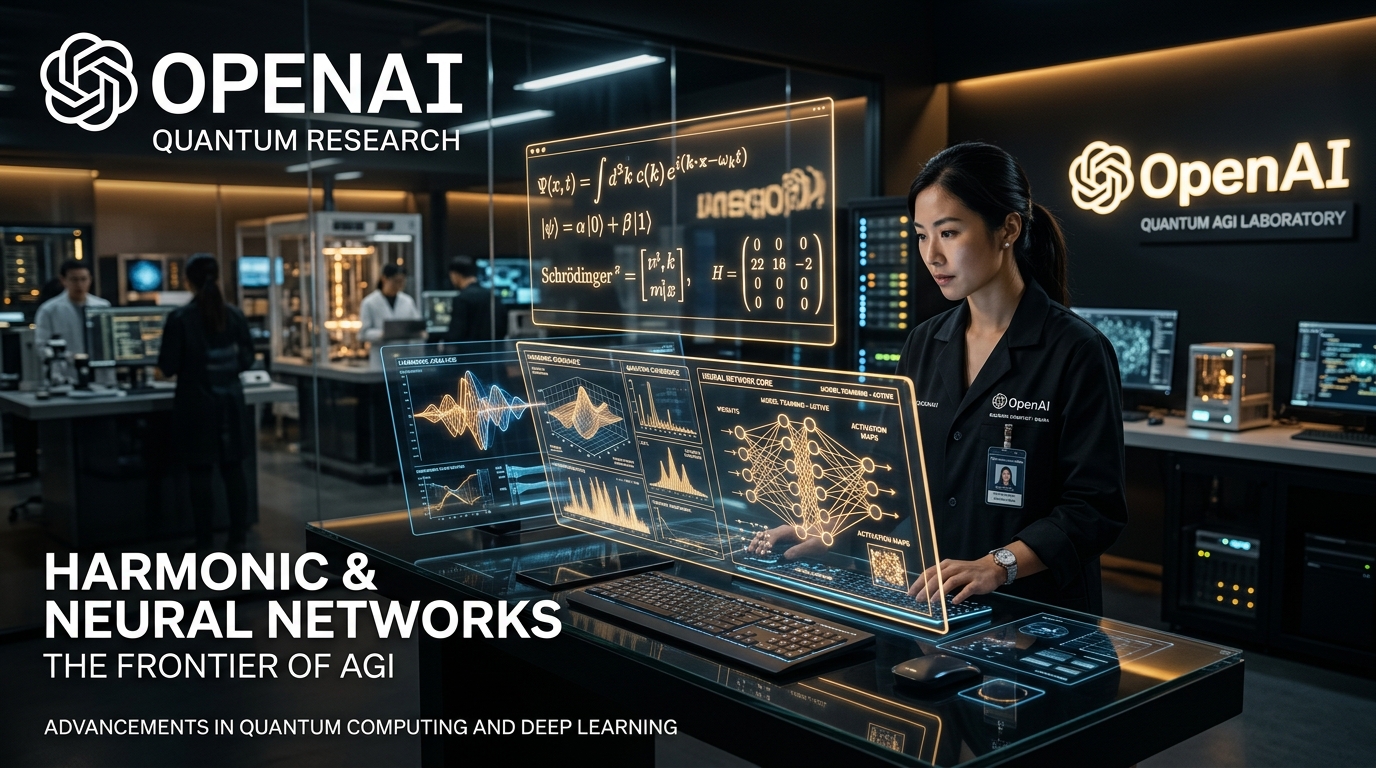
Overview: Frontier Science and Computer-Use Automation
Artificial intelligence is moving beyond answering questions and generating content. It is increasingly being used to explore complex scientific problems, assist researchers, and automate real-world computer tasks.
On October 26, 2026, OpenAI announced three AI-assisted scientific findings spanning mathematics, computer science, and physics. Concurrently, the company introduced GPT-6.1 Terra, a model engineered to deliver faster, more cost-effective performance, particularly for computer-use tasks.
These dual developments highlight two important directions for modern AI: accelerating fundamental scientific research and helping people complete complex digital workflows.
What Are OpenAI's Three Scientific Discoveries?
OpenAI's research announcement describes three significant results produced with the assistance of its frontier AI models. The findings cover harmonic analysis, computational complexity theory, and quantum field theory.
Although these results are immensely promising, OpenAI and the scientific community emphasize that they still require appropriate independent scrutiny and peer evaluation before their broader scientific implications can be considered established.
1. Mathematics: Harmonic Analysis
What is harmonic analysis?
Harmonic analysis is a branch of mathematics that studies functions and signals by examining their underlying components, including wave-like patterns and frequencies. It has widespread applications in signal processing, image analysis, differential equations, and many other scientific fields.
What did OpenAI announce?
OpenAI reported an AI-assisted proof of the local smoothing conjecture in every spatial dimension, with deep implications for related mathematical conjectures such as the Kakeya conjecture and Stein's restriction conjecture.
Why does it matter?
If independently validated, this result could advance mathematical research involving wave equations and harmonic analysis. Mathematical conjectures often remain unresolved for decades because their proofs require sophisticated geometric reasoning. AI systems capable of helping researchers construct rigorous mathematical proofs could accelerate progress on long-standing open questions.
2. Computer Science: Complexity Theory
What is computational complexity theory?
Computational complexity theory examines the resources required to solve computational problems—particularly how an algorithm's time and memory requirements scale as the input grows. For example, an algorithm that processes a small dataset quickly may become computationally intractable when the dataset becomes significantly larger.
What did OpenAI announce?
OpenAI reported an AI-generated disproof of the Exponential Time Hypothesis (ETH), a widely studied assumption concerning the computational difficulty of certain Boolean satisfiability problems. The announcement also describes verification of critical components of the result using Lean, a formal proof assistant that verifies whether a mathematical argument strictly follows from its stated axioms and encoded rules.
Why does it matter?
If the result withstands independent peer review, it could reshape theoretical computer science and the fundamental assumptions researchers use when analyzing algorithms. However, this does not mean that all computationally difficult problems have suddenly become easy or that existing software will automatically run faster.
3. Physics: Quantum Field Theory
What is quantum field theory?
Quantum field theory (QFT) combines quantum mechanics with special relativity to describe fundamental particles and their interactions through quantum fields. It provides the theoretical foundation for much of modern particle physics and the Standard Model.
What did OpenAI announce?
OpenAI reported a mathematical existence proof for certain four-dimensional interacting quantum field theories, including theories related to Quantum Chromodynamics (QCD). Quantum chromodynamics describes the strong nuclear interaction responsible for binding quarks together inside particles such as protons and neutrons.
Why does it matter?
Establishing the rigorous mathematical foundations of interacting quantum field theories has been one of mathematical physics' most challenging open problems. A rigorous existence proof could contribute substantially to our understanding of the mathematical structures underlying fundamental physics. The broader significance will depend on thorough examination by theoretical physicists and mathematicians.
How Does AI Help Make Scientific Discoveries?
AI-assisted scientific research involves far more than generating a plausible answer. Researchers need to examine the underlying reasoning, test boundary assumptions, and establish whether the conclusions are mathematically and scientifically sound.
A simplified AI-driven research workflow follows four stages:
- 1. Problem identification: Researchers formulate an open mathematical or scientific problem and encode its boundary constraints.
- 2. Solution generation: An AI reasoning model explores vast proof spaces, develops symbolic arguments, and proposes candidate solutions.
- 3. Formal verification: Where possible, researchers translate arguments into machine-checkable formal languages such as Lean to detect flaws.
- 4. Independent review: Human specialists investigate assumptions, mathematical validity, edge cases, and physical interpretations.
The Role of Formal Verification
Formal verification is particularly valuable because proof assistants can eliminate human oversight errors in formal derivations. However, it does not automatically guarantee that the original real-world problem was modeled correctly or that every scientific interpretation is justified.
The broader opportunity is to use AI as an tireless research assistant that helps scientists explore hypotheses and generate candidate proofs that might otherwise require decades of manual trial and error.
What Is GPT-6.1 Terra?
GPT-6.1 Terra is described by OpenAI as a fast, lower-cost AI model intended for practical production work, with a particular emphasis on computer-use automation.
Traditional chatbots primarily respond to user prompts with text, code snippets, or static generated content. In contrast, a computer-use agent can interact with supported desktop and web applications through tools and execute complex sequences of actions.
For example, rather than simply explaining how to clean a spreadsheet, an appropriately configured agent could inspect the spreadsheet, locate missing information, execute transformations, and format an executive summary.
Terra is engineered to support this operational workload while delivering optimal balance across speed, cost, and capability.
Generate text, code snippets, and conversational explanations within a chat window.
Visually navigates software, operates controls, enters data, and executes end-to-end digital tasks.
Key Features of GPT-6.1 Terra
OpenAI designed GPT-6.1 Terra with four core capabilities that make it well-suited for autonomous computer-use workflows:
- 1. Computer-Use Automation: Allows the agent to interact directly with supported software interfaces—clicking buttons, navigating menus, entering information, and executing repetitive administrative workflows.
- 2. Coding Assistance: Enables developers to inspect codebases, troubleshoot bugs, generate implementations, and run tests rapidly with reduced latency and lower API costs.
- 3. Visual Understanding: Interprets complex screen layouts, interface widgets, technical drawings, and unstructured documents visually rather than relying solely on raw text.
- 4. Multistep Task Execution: Decomposes complex user goals into atomic actions, checks intermediate results, recovers from errors, and progresses toward the final objective.
How Does GPT-6.1 Terra Work?
A typical computer-use workflow with GPT-6.1 Terra follows a five-step loop:
Importantly, the model itself does not possess unrestricted system access. Safe computer interaction requires a sandboxed environment, connected tool APIs, and strict user permissions.
- Step 1: Understand the request — The user defines the desired goal, such as auditing a spreadsheet or extracting invoice details.
- Step 2: Observe available information — The model examines current screen pixels, document trees, or application state.
- Step 3: Plan and execute actions — The agent computes the next action (click, keystroke, API call) and executes it via connected tooling.
- Step 4: Inspect the result — The agent evaluates whether the action succeeded or if corrections are required.
- Step 5: Report completion — The agent summarizes deliverables and highlights items that need human approval.
Release Date and Availability
According to OpenAI's announcement, GPT-6.1 Terra was officially released on October 26, 2026.
Availability spans three primary channels:
• ChatGPT Work: Available for enterprise and team workspace subscribers.
• Codex: Integrated for developers carrying out automated code review and test generation.
• API Access: Available globally under the API model identifier gpt-6.1-terra.
The model is priced affordably to enable high-volume agentic loops and screen-interaction pipelines without incurring excessive API overhead.
How to Use GPT-6.1 Terra
Users and developers can access GPT-6.1 Terra through three flexible methods:
Method 1: Using ChatGPT Work
Open ChatGPT and select the Work workspace. Select GPT-6.1 Terra from the model selector, attach files or grant application tool permissions, and specify the objective.
“Analyze this spreadsheet, identify missing values, summarize the important findings, and prepare an executive report.”
Method 2: Using Codex
Open Codex, choose Terra as the active model, connect your repository, and describe the engineering task.
“Inspect this Python project, identify why the integration tests are failing, explain the root cause, and propose the smallest reliable fix.”
Method 3: Using the OpenAI API
Developers can invoke
gpt-6.1-terra within existing automation frameworks, supplying screen frames, coordinate actions, or tool definitions.Practical Applications of GPT-6.1 Terra
GPT-6.1 Terra unlocks practical efficiencies across key organizational workflows:
- Software development: Automated bug investigation, test writing, dependency updates, and boilerplate code generation.
- Business operations: Reconciling spreadsheet data, drafting reports, generating purchase orders, and handling repetitive back-office workflows.
- Document processing: Parsing unstructured forms, verifying contract fields, and converting unstructured receipts into structured JSON.
- Workflow automation: Orchestrating complex cross-application tasks that previously required human manual clicking and entry.
- Property management: Organizing property listings, auditing missing disclosure fields, and updating leasing databases automatically.
GPT-6.1 Terra vs. AI Research Models
The scientific discoveries and GPT-6.1 Terra represent two vital, complementary vectors of AI development:
Focus on long-horizon symbolic reasoning, novel mathematical lemmas, formal proofs, and rigorous peer validation.
Focuses on latency, unit economics, visual GUI navigation, reliability, and automated tool-driven task execution.
While scientific models prioritize mathematical truth, computer-use models like Terra prioritize task completion, reliability, execution speed, cost efficiency, and recovery from environmental errors.
Challenges and Limitations
Despite their impressive potential, AI-assisted scientific discovery and computer-use agents come with clear limitations that require vigilance:
- Independent verification: Scientific claims require rigorous scrutiny by academic experts even when accompanied by formal Lean proofs.
- Agent reliability: Autonomous agents can misinterpret ambiguous visual UI states or perform incorrect sequences of actions.
- Security & least-privilege: System access must be strictly constrained to necessary sandboxes to prevent unintended data exposure or file modifications.
- Human-in-the-loop oversight: Critical operations—such as production deployments or financial transactions—should always require explicit human approval.
- Cost-performance tradeoffs: Balancing model size against task complexity is crucial for economically viable production automation.
Conclusion and Official Sources
OpenAI's three scientific findings and GPT-6.1 Terra highlight two promising directions for artificial intelligence: expanding the frontier of human scientific inquiry and streamlining everyday practical digital work.
Neither breakthrough replaces human ingenuity. Fundamental scientific discoveries require deep validation by domain specialists, while automated computer-use agents require thoughtful system boundaries, clear permissions, and continuous monitoring.
For detailed technical papers, model cards, and official announcements, explore OpenAI's documentation:
The Dual Frontier of Modern AI
From “Simple chatbot answers and static code generation”
To “Autonomous scientific proof discovery and agile computer-use agents.”