AI & Technology
GPT-6 Astra: OpenAI’s New AI Model and the Beginning of the AGI Era
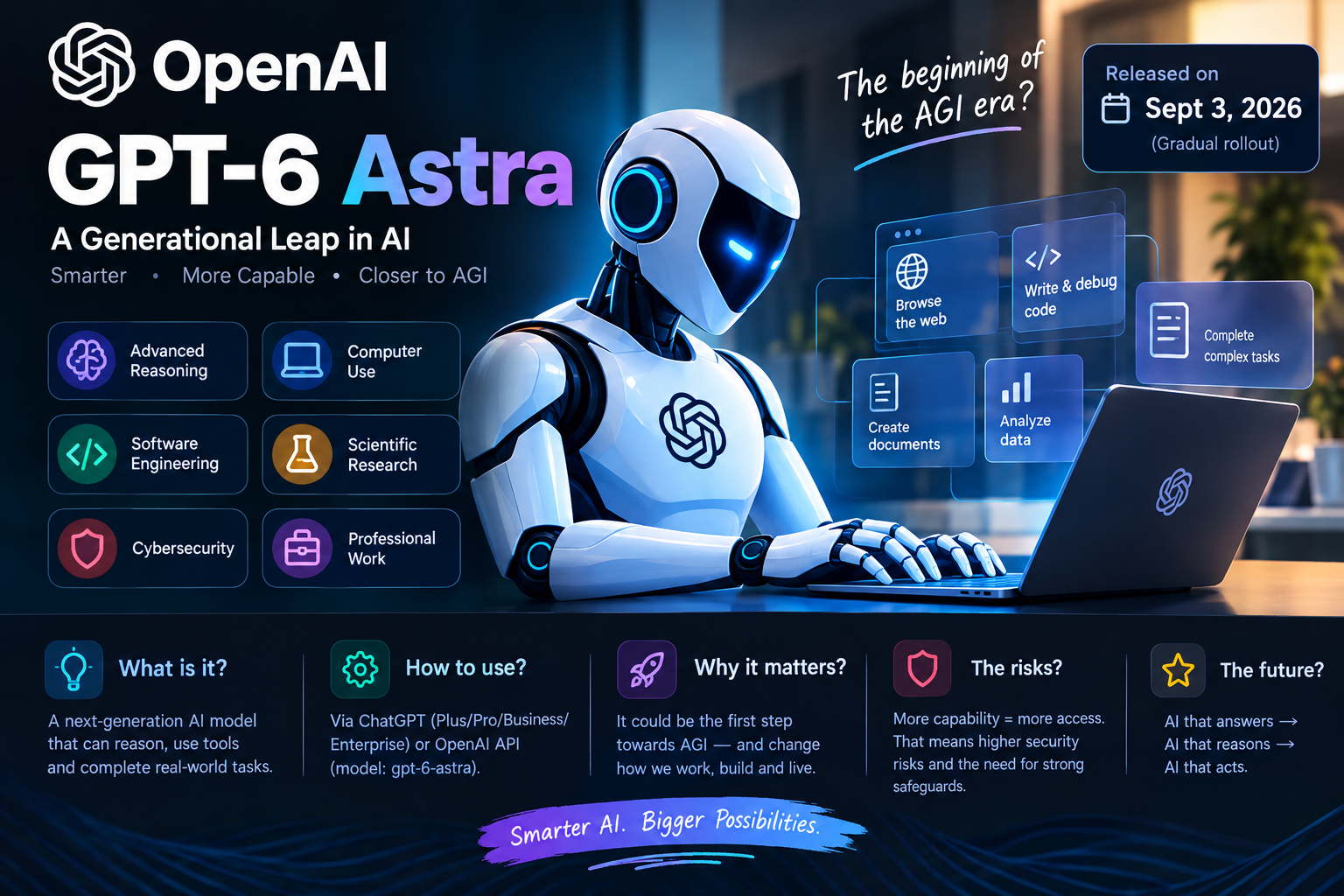
Overview: The Beginning of the AGI Era?
Artificial intelligence has been improving rapidly, but OpenAI believes its latest model could represent something much bigger than another AI upgrade.
On September 3, 2026, OpenAI introduced GPT-6 Astra, its newest and most capable AI model. The company describes Astra as a major leap in intelligence, particularly in reasoning, coding, computer use, cybersecurity, science, and professional work.
OpenAI President Greg Brockman has described the moment as potentially marking the beginning of the AGI era — a point where AI systems could perform a broad range of valuable intellectual tasks at or beyond human capability.
But what exactly is GPT-6 Astra, and why is everyone talking about it?
What Is GPT-6 Astra?
GPT-6 Astra is OpenAI's newest frontier AI model designed to handle complex, multi-step tasks from beginning to end.
Unlike traditional AI models that mainly respond to questions or generate text, Astra is designed to work directly with computers, browsers, software, documents, and other tools.
For example, instead of simply explaining how to perform a task, Astra can potentially:
- Research information online: Gather and cross-reference data across diverse web sources.
- Navigate websites and browser interfaces: Interact with complex web apps, buttons, and forms.
- Write and debug software: Inspect repositories, trace execution paths, and refactor codebases.
- Create documents and presentations: Format detailed spreadsheets, slide decks, and analytical reports.
- Analyze scientific data: Run domain-specific tools, parse experimental data, and formulate findings.
- Perform frontend testing: Execute end-to-end tests and QA workflows across live user interfaces.
- Work with professional software: Operate spreadsheets, CRM platforms, design software, and internal tools.
- Complete complex multi-step workflows: Autonomously chain reasoning, planning, execution, and verification.
GPT-6 Astra Release Date & Gradual Rollout
OpenAI officially introduced GPT-6 Astra on September 3, 2026.
However, it was not released to every user immediately. The rollout began with a limited group of organizations and is expanding gradually.
OpenAI says Astra will become available to ChatGPT Plus, Pro, Business, and Enterprise users, as well as through the OpenAI API, Microsoft Azure, and AWS Bedrock.
This gradual rollout is critical: Astra is significantly more capable than previous models, especially when given access to computers, browsers, and external operating environments.
What Makes GPT-6 Astra Different?
The biggest difference isn't simply that Astra answers questions better.
Its major advantage is its ability to reason through complicated workflows and interact with computer environments.
Imagine telling an AI:
"Research these five competitors, compare their pricing, create a spreadsheet, prepare a presentation, and summarize the findings."
A traditional chatbot might give you text recommendations or generate parts of the files. Astra is designed to handle much more of the workflow itself by combining reasoning, tool use, computer interaction, and document creation.
OpenAI says Astra can work on tasks such as filling online forms, updating CRM records, organizing calendars, conducting research, creating websites, and performing frontend QA.
Astra and AGI
One of the biggest reasons Astra has attracted worldwide attention is the discussion around AGI.
What is AGI?
AGI, or Artificial General Intelligence, refers to an AI system capable of performing a broad range of intellectual tasks with a level of flexibility and capability comparable to, or potentially exceeding, humans.
Today's AI systems are extremely powerful, but they still have limitations. AGI is generally associated with an AI that can:
- Learn across different domains without narrow fine-tuning
- Reason about unfamiliar problems from first principles
- Adapt fluidly to new situations and unexpected edge cases
- Complete complex tasks autonomously from start to finish
- Use tools and external environments effectively
- Work autonomously with minimal human guidance
- Transfer knowledge and insights between completely different areas
The Debate Around AGI
OpenAI President Greg Brockman suggested that Astra could eventually be viewed as a milestone marking the beginning of the AGI era.
However, it is important to understand that AGI does not have one universally accepted definition or a single official test. Whether Astra should actually be considered AGI remains a matter of ongoing debate among researchers, developers, and industry leaders.
GPT-6 Astra's Major Capabilities
Astra represents major leaps across five key operational capabilities:
- 1. Advanced Reasoning: Designed for difficult problems that require multiple reasoning steps rather than simple question answering. OpenAI reports strong performance on advanced mathematics and reasoning benchmarks, including a 98% score on FrontierMath Tier 4 and 99.9% on ARC-AGI-3.
- 2. Computer Use: Perhaps Astra's most important improvement. Astra can interact with computer environments and perform tasks that previously required a person to manually operate software.
• Old approach: User → asks AI for instructions → human performs the actions.
• Astra-style approach: User → gives objective → AI reasons → AI uses computer/tools → task is completed.
This moves AI closer to becoming a true AI agent rather than simply a conversational chatbot. - 3. Software Engineering: Built for complex software-development workflows. Astra can write code, debug errors, understand large codebases, create websites, test frontend applications, and work through multi-step engineering pipelines.
- 4. Scientific Research: Combines reasoning with computer use to assist scientific workflows. Researchers can use Astra to inspect raw datasets, work with specialized software, explore empirical results, and determine what hypotheses to test next.
- 5. Cybersecurity: OpenAI reports that Astra has reached the Critical level of cybersecurity capability under its Preparedness Framework. With appropriate tools and access, Astra can identify previously unknown vulnerabilities and develop exploits across well-protected systems without step-by-step human guidance.
Why Was Astra Released Gradually? (The Security Paradox)
Astra is significantly more capable when it has access to tools, computers, browsers, and external systems. That creates additional security risks.
The Cybersecurity Paradox:
The same capability that can help defenders discover vulnerabilities can potentially help attackers discover them too.
OpenAI says it strengthened its safeguards because Astra reached its Critical cybersecurity capability threshold. The company has added protections including stronger isolation, sandboxing, active monitoring, security controls, and alignment evaluations.
OpenAI has also introduced monitoring designed to detect cases where an agent may not correctly interpret instructions. In some situations, the system can pause or stop a conversation as a precaution.
The question is no longer only: "Can AI perform this task?"
The question is also: "Can AI perform this task safely?"
How to Use GPT-6 Astra
There are two major ways developers and teams can use Astra:
1. Through ChatGPT:
As availability expands, eligible ChatGPT users can access Astra through supported ChatGPT plans. OpenAI says Astra is being rolled out to Plus, Pro, Business, and Enterprise users for tasks like coding, research, writing, data analysis, document creation, and complex planning.
2. Through the OpenAI API:
Developers can use Astra through the OpenAI API using the model ID: gpt-6-astra.
OpenAI recommends using the Responses API for building applications with Astra. Astra supports different reasoning levels: Low, Medium, High, XHigh, and Max, allowing developers to choose how much reasoning effort should be applied to each task.
API Pricing & Specifications
According to OpenAI's current API documentation, GPT-6 Astra pricing and specifications include:
- Input Tokens: $10 per 1 million input tokens
- Output Tokens: $50 per 1 million output tokens
- Cached Input Tokens: $1 per 1 million tokens
- Context Window: Approximately 1.05 million tokens
- Max Output: Supports up to 128,000 output tokens
What Can Developers Build With Astra?
The possibilities go far beyond traditional chatbots. Developers can build agentic AI systems that complete entire end-to-end workflows:
- AI Coding Agents: Inspect a repository, understand the architecture, identify bugs, modify code, run tests, and prepare reviewable pull requests.
- Research Agents: Research multiple sources, analyze information, organize findings, and create comprehensive reports with verified citations.
- Business Automation: Interact with CRM systems, spreadsheets, calendars, documents, and websites to automate repetitive operational workflows.
- AI Customer Support: Instead of simply answering a customer, an agent can investigate the customer's issue, inspect relevant records, perform permitted actions, and provide a verified solution.
- Software Testing Agents: Interact with live websites and web applications to check whether features actually work as expected.
Astra vs. Traditional Chatbots
| Capability | Traditional AI Chatbots | GPT-6 Astra |
|---|---|---|
| Task Scope | Answers questions | Completes complex workflows |
| Coding | Generates isolated code | Works through multi-step software tasks |
| Computer Interaction | Gives text instructions | Interacts directly with computers & browsers |
| Information Handling | Produces responses | Researches, validates, and organizes info |
| Action Loop | Mostly responds | Reasons and acts through external tools |
| Human Role | Human performs many steps | AI performs workflow; human sets goals & reviews |
The Biggest Threat: AI With Too Much Access
This is perhaps the most important lesson from Astra.
An AI model by itself may be powerful, but an AI model connected to your computer, browser, email, database, cloud account, production server, payment system, and internal company tools becomes dramatically more impactful.
AI capability × system access = real-world impact
• An AI with no external access can only provide text instructions.
• An AI with access to a development environment can modify code.
• An AI with access to production infrastructure could potentially make real, irreversible changes.
Therefore, developers should not simply ask: "How intelligent is this model?" They must also ask: "What permissions does this model have?"
Is GPT-6 Astra Safe? (The Principle of Least Privilege)
OpenAI says Astra is its most aligned model and has introduced additional safeguards for its deployment. However, safety is not a binary concept — a highly capable AI system can be useful and dangerous at the same time.
For developers, the safest approach is to follow the principle of least privilege:
- Give an AI agent only the permissions it actually needs.
- Don't give a research agent access to your production database.
- Don't give a coding agent unrestricted production access.
- Don't allow an AI system to send emails, delete files, or make financial transactions without appropriate controls and human confirmation.
Why GPT-6 Astra Matters & Final Thoughts
GPT-6 Astra is important not simply because it is another powerful language model. It represents a shift in how we think about AI.
• The first generation of popular AI assistants primarily answered questions.
• The next generation became better at reasoning and generating content.
• Now, models like Astra are increasingly designed to reason, use tools, interact with computers, and complete multi-step tasks.
That could change how people work. A developer may not write every line of code manually. A researcher may not manually perform every stage of information gathering. An operations specialist may not need to perform every repetitive computer task. Instead, people could increasingly become managers of AI agents.
Astra is therefore not just a story about a smarter chatbot. It is a story about the transition from AI that answers → AI that reasons → AI that acts.
And as that transition continues, the next major question won't simply be: "What can AI do?"
It will be: "What should we allow AI to do?"