AI & Technology
Google Project Suncatcher: Is the Future of AI Data Centers in Space?
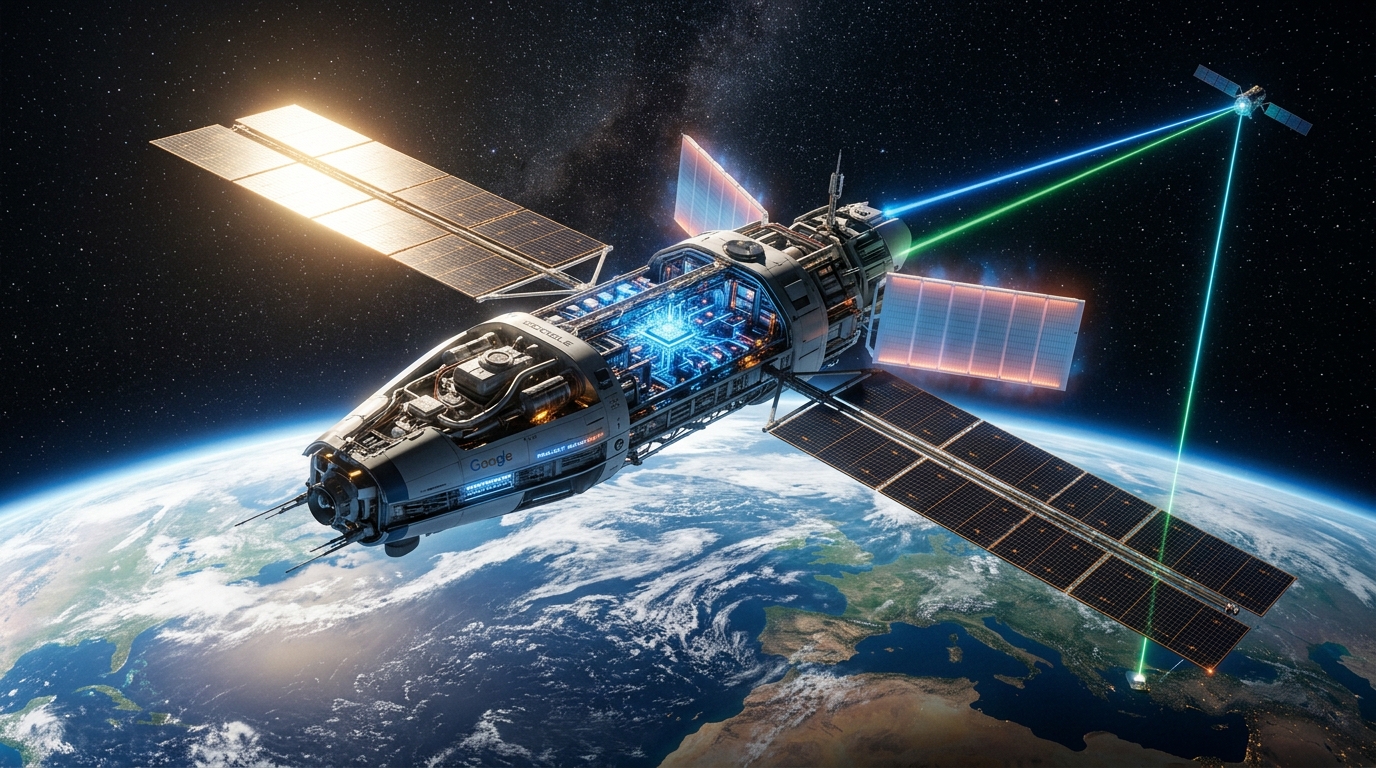
Overview: AI Computing Beyond Earth
Artificial intelligence is becoming more powerful, but that progress comes with a major challenge: AI requires enormous amounts of computing power and electricity.
Google is exploring a very unusual solution — putting AI computing infrastructure in space.
The project, called Project Suncatcher, aims to investigate whether satellites equipped with Google's AI processors could eventually work together as an orbital computing system powered primarily by sunlight.
Google announced Project Suncatcher in November 2025, and its first experimental satellite is scheduled for launch on October 1, 2026.
What is Project Suncatcher?
Project Suncatcher is a Google research project focused on exploring space-based AI computing.
Instead of building every future AI data center on Earth, Google is investigating whether specialized satellites could carry AI processors and use solar energy to perform computing tasks in orbit.
The idea is still experimental. Google is not launching a giant orbital data center yet.
The first mission is designed to answer a simpler question:
“Can AI hardware operate reliably in space?”
Google's First AI Satellite: 4 TPUs in Orbit
For the first test, Google plans to launch a refrigerator-sized satellite containing four Tensor Processing Units (TPUs).
TPUs are Google's specialized processors designed to accelerate artificial intelligence and machine-learning workloads.
The satellite will be used to test how these processors perform in the harsh environment of space.
The planned launch date is October 1, 2026, as part of a SpaceX rideshare mission.
This mission is important because laboratory testing can only simulate space conditions to a certain extent. Operating an actual AI processor in orbit can reveal problems that may not appear during testing on Earth.
Why Does Google Want AI in Space? Solar Power
One of the biggest reasons is energy.
AI models require increasingly large amounts of computing power. More computing means more electricity and more infrastructure for cooling data centers.
Space offers an interesting potential advantage: abundant sunlight.
Satellites operating in suitable orbits can receive sunlight for much of their time in orbit. Solar panels could convert that sunlight into electricity and provide power for AI processors.
The basic concept looks like this:
If the technology eventually becomes practical, Google could potentially build large networks of computing satellites instead of relying entirely on traditional terrestrial data centers.
The Thermal Bottleneck: Dissipating Heat in Vacuum
Putting an AI processor in space doesn't automatically make cooling easier.
AI chips generate heat, and traditional data centers use systems such as fans and liquid cooling to remove that heat.
Space doesn't have an atmosphere, so you can't simply use air to carry the heat away.
Instead, spacecraft have to use radiators to release heat into space via thermal radiation.
Google is therefore testing specialized thermal systems involving technologies such as heat pipes and radiators.
This is one of the major engineering challenges that Project Suncatcher needs to solve.
Radiation Hardening: Can AI Chips Survive Space Weather?
Another major challenge is radiation.
Space contains high-energy particles that can interfere with electronic components. Radiation can potentially cause errors or damage hardware over time.
Google has already conducted radiation testing on its TPU hardware on Earth.
However, an actual orbital mission provides a different kind of test.
The satellite will allow Google to observe how the TPUs behave during real-world space operations.
Inter-Satellite Laser Links: Orbital Mesh Networking
The long-term vision of Project Suncatcher isn't based on just one satellite.
Google is investigating a future system in which many satellites could work together.
These satellites could potentially communicate using high-speed laser links.
For example:
This could allow computing workloads and information to move between different satellites.
However, maintaining a laser connection between rapidly moving satellites is extremely difficult. The spacecraft have to precisely point their communication systems at one another while constantly moving through orbit.
Google plans to investigate these inter-satellite communication challenges in future experiments.
What Could an Orbital AI Data Center Look Like?
Imagine hundreds or thousands of satellites orbiting Earth.
Each satellite could contain: AI processors, solar panels, memory and storage, cooling systems, and communication equipment.
Together, these satellites could potentially operate as a distributed computing network.
Instead of one massive building filled with AI hardware, the computing infrastructure could be spread across a constellation of satellites.
The concept would look something like:
This is the long-term vision, not what Google is deploying today.
- Solar Panels: Collecting uninterrupted solar energy to power processors in orbit.
- TPU Accelerators: Performing high-throughput AI inference and training workloads in zero gravity.
- Radiator Arrays: Emitting thermal waste away from computing racks into deep space.
- Optical Laser Interconnects: Ultra-low latency laser meshes passing data seamlessly between orbital nodes.
- Ground Station Uplinks: Synchronizing data and tasks between terrestrial cloud regions and space constellations.
What Are the Biggest Challenges?
Project Suncatcher still has several difficult problems to solve:
| Challenge | Impact | Technical Consideration |
|---|---|---|
| 1. Cooling | Extreme chip heat | AI processors produce significant heat, and removing that heat in space is difficult without atmospheric convection. |
| 2. Radiation | Bit flips & component fatigue | Space radiation can affect electronic components and cause computing errors. |
| 3. Launch Costs | Payload economics | Every satellite has to be transported into orbit, adding significant costs to the infrastructure. |
| 4. Maintenance | No physical servicing | A traditional data center can be repaired by engineers. Repairing a satellite in orbit is much more complicated. |
| 5. Communication | Orbital laser tracking | A large satellite constellation would require extremely reliable, high-speed communication between spacecraft. |
| 6. Economics | Ground vs. space ROI | Google still needs to determine whether operating AI infrastructure in space makes economic sense compared with building data centers on Earth. |
- 1. Cooling: AI processors produce significant heat, and removing that heat in space is difficult.
- 2. Radiation: Space radiation can affect electronic components and cause computing errors.
- 3. Launch Costs: Every satellite has to be transported into orbit, adding significant costs to the infrastructure.
- 4. Maintenance: A traditional data center can be repaired by engineers. Repairing a satellite in orbit is much more complicated.
- 5. Communication: A large satellite constellation would require extremely reliable, high-speed communication between spacecraft.
- 6. Economics: Even if the technology works, Google still needs to determine whether operating AI infrastructure in space makes economic sense compared with building data centers on Earth.
When Will Project Suncatcher Launch?
Google's first Suncatcher test is scheduled for:
The mission is a technology demonstration rather than a commercial launch of a space-based Google Cloud data center.
Future experiments are expected to investigate additional technologies, including communication between satellites.
What Could This Mean for the Future of AI?
Project Suncatcher represents a different way of thinking about the future of AI infrastructure.
Today, when we think about AI computing, we usually imagine enormous buildings filled with servers, GPUs, TPUs, cooling systems and power infrastructure.
Google is asking a different question:
“What if some of that computing infrastructure could eventually operate in space?”
If the technology proves practical, future AI infrastructure could potentially combine solar power, specialized AI chips and satellite networks.
However, that future is still uncertain.
The October 2026 mission is an experiment designed to determine whether the basic technology can work reliably outside Earth's atmosphere.
Final Thoughts: The Orbital AI Frontier
Google's Project Suncatcher sounds like science fiction, but the company is now beginning to test the idea with real hardware.
The first satellite will carry just four TPUs, making it tiny compared with today's massive AI data centers. But its purpose isn't to provide enormous computing capacity.
Its purpose is to learn.
Google wants to discover how AI processors behave in space, how effectively they can be cooled, how they handle radiation and whether satellites can eventually communicate with one another at the speeds required for AI workloads.
If these experiments succeed, they could provide a foundation for a very different kind of computing infrastructure — AI data centers that operate in orbit and use the Sun as their primary energy source.
For now, Project Suncatcher remains an ambitious research experiment. But its first test on October 1, 2026, could provide an important look at whether the future of AI computing might extend beyond Earth.
Key Takeaway:
“If Project Suncatcher succeeds, orbital AI data centers powered by limitless solar irradiance could redefine how humanity scales planetary-scale compute.”