AI & Technology
Ghost Core: The AI-First Personal Computer That Works for You
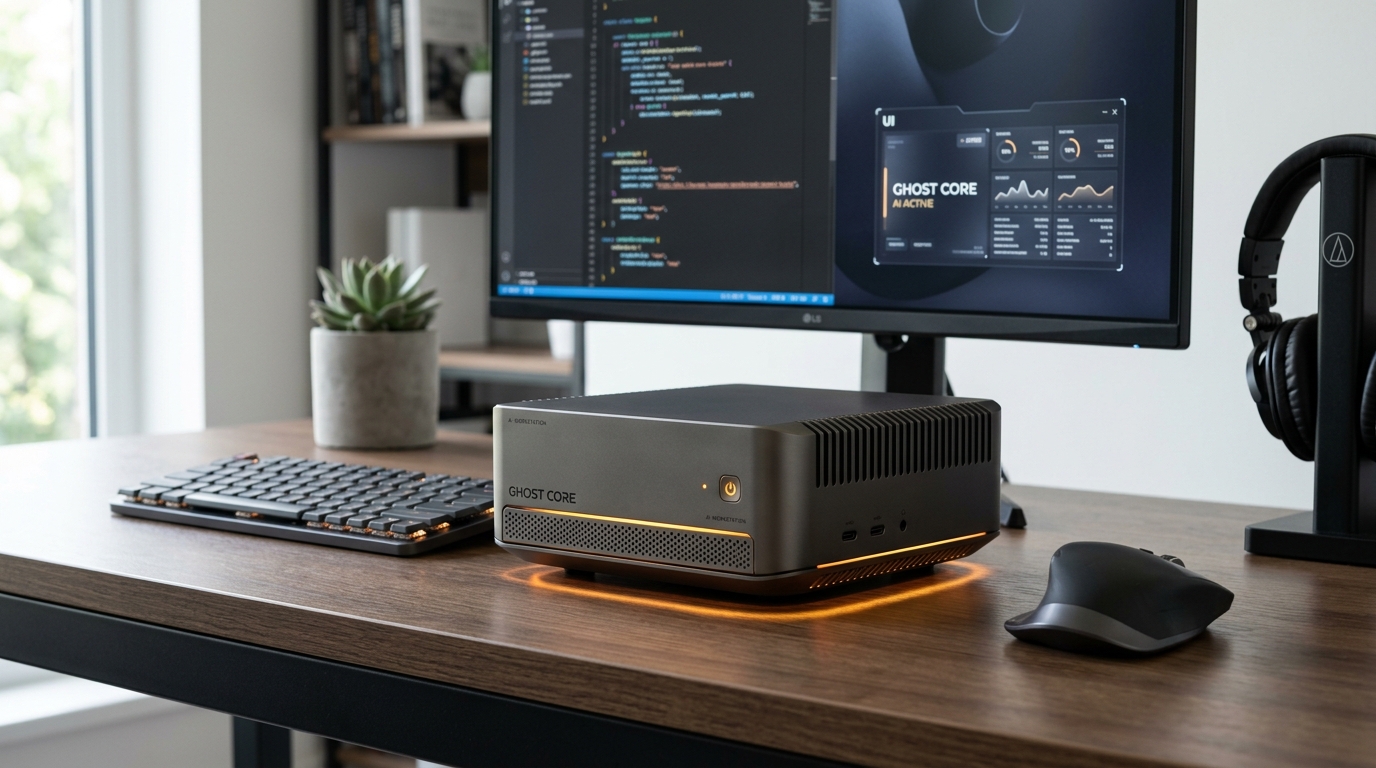
Overview: An AI-First Computer That Works for You
The personal computer may be entering a new era where users no longer have to control every task themselves. Ghost AI, led by 19-year-old founder Zain Javaid, has emerged from stealth with Core, an AI-first personal computer designed to run artificial intelligence continuously and help users complete tasks across their digital lives.
Unlike a traditional computer that waits for users to open applications and perform tasks, Ghost Core is designed around AI agents, continuous context, memory, and automation. The company wants Core to become more than a computer — it aims to make it a personal AI system that works for you 24/7.
What Is Ghost Core?
Ghost Core is a dedicated personal computer designed specifically for running AI models and agents.
The key idea behind Core is simple: instead of using AI only when you open an application and type a prompt, Core is designed to continuously run AI on your behalf.
It can connect with applications, files, devices, and other digital services. Over time, it can build context about the information you provide and use that context to help perform tasks.
In simple terms:
You operate the computer.
You ask the AI to help.
The AI is designed to continuously work on your behalf.
Who Created Ghost Core?
Ghost AI was founded by Zain Javaid, who was just 19 years old when the company emerged from stealth.
The company has attracted significant attention because it is trying to combine powerful local AI hardware with autonomous AI agents.
Ghost AI also announced an $11 million seed funding round, backed by prominent investors including Andreessen Horowitz (a16z).
When Was Ghost Core Released?
Ghost AI publicly introduced Core in October 2026 when the company came out of stealth.
The product is currently positioned as a premium AI computer, with Ghost listing the Core at around $3,499.
The launch comes at a time when several companies are exploring a new category of AI-first hardware, where AI is not simply an application running on a computer but a central part of the computing experience.
How Does Ghost Core Work?
Core is built around several foundational architectural principles and technologies designed to provide genuine autonomous capabilities and local compute independence.
1. On-Device AI Architecture
One of the biggest ideas behind Core is running AI models directly on the device.
Traditional AI services often work like this:
Core is designed to move much of this processing onto the local machine:
This can provide advantages such as privacy, reduced dependence on cloud services, and the ability to run AI models locally.
Ghost says Core supports local models including models from the Qwen and Gemma families, while also allowing users to work with additional models.
2. Continuous Context and Long-Term Memory
Another major feature is continuous context.
Most AI assistants start with very limited information about what you are doing. You provide a prompt, the AI processes it, and the conversation continues in isolation.
Core is designed to maintain useful information over time. For example, imagine you regularly work on a software project. You may have:
Instead of treating every interaction as a completely new conversation, Core is designed to use relevant context from these connected sources. This could allow the AI to provide more personalized assistance.
- Project documents and architectural specifications
- Emails and communication history
- Calendar meetings and upcoming appointments
- Local files, datasets, and spreadsheets
- Notes and idea scratchpads
- Browser activity and research pages
- Development information and code repositories
3. Autonomous AI Agents vs. Chatbots
Core is also focused on AI agents rather than just chatbots.
A chatbot primarily answers questions. An AI agent can potentially execute a continuous loop:
For example, instead of asking:
“What meetings do I have tomorrow?”
you could ask:
“Prepare me for tomorrow's meetings.”
An agent could potentially find the relevant calendar events, locate related documents and information, and organize everything into a useful summary.
4. Connections With Apps and Devices
Core is designed to work with connected applications and devices. The idea is to give the AI access to the tools and information required to perform useful tasks.
Of course, what Core can actually do depends on the integrations available and the permissions given by the user.
- Email: Reading communications, tracking threads, and preparing replies.
- Calendar: Monitoring schedules and preparing contextual briefings.
- Files: Indexing local folders, codebases, and media assets.
- Browser: Browsing web resources and synthesizing research.
- Smart-Home Devices: Automating connected hardware and ambient controls.
- Wearables: Syncing health and daily activity data.
- Connected Services: Interfacing with cloud APIs and productivity tools.
What Hardware Does Core Have?
Running powerful AI models locally requires significant computing power.
Ghost lists the following hardware specifications for Core:
This hardware makes Core considerably different from a typical mini PC. Instead of focusing primarily on traditional desktop applications, the machine is designed to provide the computing resources required for local AI workloads.
How Do You Use Ghost Core? The 5-Step Process
The basic experience can be thought of in five straightforward steps:
- Step 1: Set Up Core — The user connects the Core computer to their network and workstation environment.
- Step 2: Connect Applications — Users can connect supported applications and services to give Core access to relevant information.
- Step 3: Give Permissions — The user controls what Core can access and which actions its agents are allowed to perform.
- Step 4: Build Context — As Core interacts with the user's connected information, it builds a better understanding of their workflow and preferences.
- Step 5: Give It Tasks — Users can then ask Core to perform tasks or allow its agents to work proactively.
A Simple Example: Autonomous Work Preparation
Imagine a software developer connects Core to their:
Now the developer says:
“Prepare everything I need for tomorrow's project meeting.”
Core could potentially execute the multi-step plan autonomously:
- Check the calendar for the meeting.
- Find related emails.
- Search project documents.
- Find relevant development information.
- Use its existing context.
- Organize the information.
- Prepare a summary.
This is where AI agents become more interesting than traditional chatbots. The AI isn't simply answering a question — it is trying to complete a goal.
Why Is Local AI Important?
Privacy is one of the major reasons companies are increasingly interested in local AI.
With cloud AI, information may need to travel to remote servers for processing. With local AI, the processing can happen directly on your computer.
That can be especially important when dealing with:
- Personal documents and private notes
- Private conversations and correspondence
- Business information and proprietary workflows
- Personal schedules and daily routines
- Sensitive files and source code repositories
Ghost Core vs. a Traditional PC
The biggest difference isn't simply the hardware. It is the role of the computer.
A traditional computer is primarily a tool that waits for instructions. An AI-first computer attempts to become an active assistant.
Open → Search → Copy → Analyze → Act
Give a goal → AI plans → AI uses tools → AI completes the task
This represents a major change in how we may interact with computers.
Why Ghost Core Matters
Ghost Core is part of a broader movement toward AI-first computing.
For decades, computers were built around operating systems and applications. Users learned how to operate those applications to accomplish tasks.
AI agents could change that model. In the future, users may not need to know which application should be opened or which buttons need to be clicked. They may simply tell the computer what they want to accomplish.
The AI could then decide which tools and applications are needed.
This is why products such as Ghost Core are interesting. They are not simply trying to make computers faster. They are exploring a different relationship between humans and computers.
The Challenges Facing Ghost Core
Despite its ambitious vision, Core also faces several challenges:
- High Price: At around $3,499, Core is significantly more expensive than many conventional computers.
- AI Reliability: AI agents still make mistakes. An agent that can take actions on your behalf must be highly reliable, especially when handling important information.
- Privacy and Security: Giving an AI access to email, files, calendars, and devices creates new security considerations.
- Real-World Performance: The long-term success of Core will depend on how well its agents actually perform complex tasks in everyday situations, not just demonstrations.
The Future of Personal Computers
Ghost Core represents a possible direction for the future of personal computing.
Today, we interact with computers through applications. Tomorrow, we may interact with them primarily through AI agents.
Instead of asking:
“Which application should I use?”
we may simply say:
“Get this done.”
The computer would then figure out the steps.
That is the larger vision behind Ghost Core: a personal computer that doesn't just provide computing power but becomes an intelligent, persistent assistant that understands your context and helps you get things done.
Conclusion
Ghost Core is an AI-first personal computer designed around local AI models, continuous context, memory, and autonomous agents.
Its goal is to move computing from a model where humans constantly operate software to one where AI can understand goals, use connected tools, remember useful information, and perform tasks on the user's behalf.
At $3,499, Core is currently a premium product, and its real-world success will depend on how reliably its AI agents can perform everyday tasks.
But the underlying idea is significant: the next generation of computers may not simply be computers that run AI — they may be computers built around AI from the ground up.
The Paradigm Shift in Computing
From “Operating applications manually”
To “Personal AI systems that continuously work on your behalf 24/7.”