AI & Technology
Figure AI’s Helix 2.5: Humanoid Robots That Can Work in Unfamiliar Homes
Overview: The Challenge of Robotic Generalization
Humanoid robots have made impressive progress in recent years, but one major challenge remains: generalization.
A robot may perform a task perfectly in an environment where it has been trained, but what happens when you move it somewhere completely new?
Figure AI is trying to solve this problem with Helix 2.5, a new AI model designed to help humanoid robots perform physical tasks in unfamiliar environments.
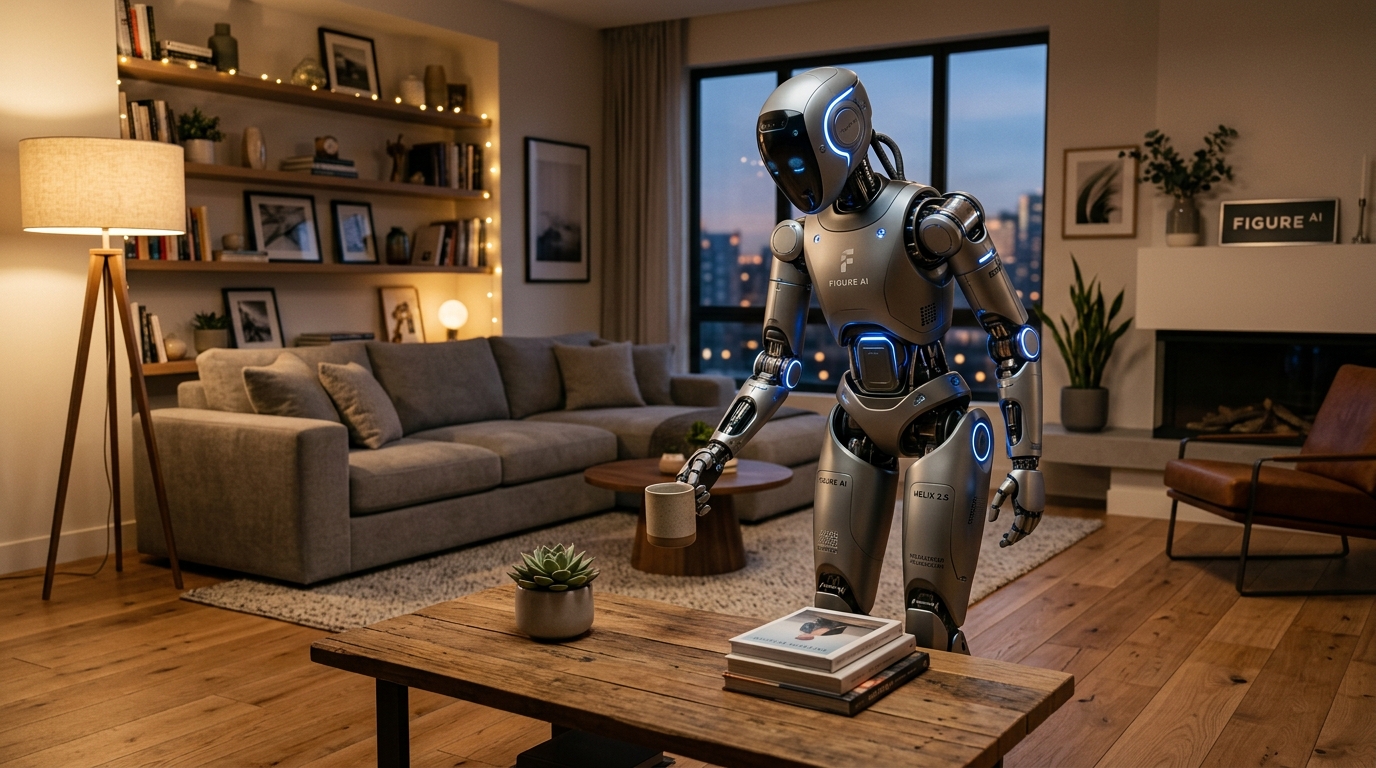
According to Figure AI, Helix 2.5 enabled its humanoid robots to perform household tasks across 30 homes they had never seen before, including tidying living rooms, folding towels, and making beds.
What Is Figure AI’s Helix 2.5?
Helix 2.5 is an AI system developed by Figure AI for controlling its humanoid robots.
Rather than controlling only an individual robot arm, the system is designed around whole-body control. The robot coordinates its vision, movement, walking, arms, hands, and physical interaction with objects.
The goal is to create robots that can understand a task and adapt their movements dynamically to the environment instead of relying on a rigid, hardcoded sequence of instructions.
Figure AI announced Helix 2.5 on September 17, 2026.
What Does “Generalization” Mean in Robotics?
Generalization means that an AI system can take what it has learned in one situation and apply that knowledge effectively to a completely different situation.
Imagine training a robot to make a bed in a single bedroom. A traditional robotics approach learns fixed, highly specific coordinates:
“Move the arm to this position, grab the blanket, move to this position, and place it here.”
That approach breaks down the moment the robot enters another bedroom with a different bed height, mattress texture, furniture arrangement, or pillow position.
A generalized robot instead understands the broader semantic task:
This perceptual grounding allows the robot to adapt its behavior to fundamentally different environments.
What Does “Zero-Shot” Mean in Physical AI?
Another foundational concept in the Helix 2.5 announcement is zero-shot learning.
In this context, zero-shot means that the robot can perform a physical task in an environment that it has never encountered during training, without first collecting new training data or calibration runs from that specific home.
For example, a robot may have learned how to fold towels from previous training experiences. When it steps into a new house, it doesn't need technicians to collect a fresh dataset for that specific laundry room before attempting the task.
Zero-shot capability is critical because manually gathering training demonstrations for every home in the world would be economically infeasible and impossibly time-consuming.
How Does Helix 2.5 Work?
At a high level, the Helix 2.5 architecture marries broad foundational pretraining with targeted task learning.
Figure AI pretrains its models using Index, its large-scale human-behavior dataset. The end-to-end operational loop flows through eight connected stages:
When entering a room, the robot's perception system maps its immediate surroundings:
- Bed Localization: Identifying where the bed is and its orientation
- Item Recognition: Detecting where towels or linens are situated
- Receptacle Identification: Finding where the laundry basket or hamper is located
- Object Segmentation: Discerning which scattered objects must be moved or sorted
- Stance & Balance: Calculating where it can safely position its feet and balance its torso
From Perception to Action: The Towel-Folding Pipeline
Once the robot understands its surroundings, it must translate that high-level understanding into a continuous sequence of whole-body physical actions.
For a towel-folding task, the execution flow progresses through distinct phases:
The core engineering hurdle is that towel dimensions, fabric stiffness, table heights, and lighting conditions vary substantially across homes.
What Did Helix 2.5 Demonstrate in 30 Unseen Homes?
Figure AI reports that Helix 2.5 was evaluated in 30 previously unseen domestic homes across three core household behaviors:
- 1. Living-Room Tidying: The robot was tasked with locating scattered toys and placing them into a designated basket. This requires dynamic room navigation, spatial obstacle avoidance, reaching under furniture, picking up irregularly shaped items, and accurately releasing them into the basket.
- 2. Folding Towels: The robot had to locate unfolded towels, manipulate them with dexterous hands, fold them along geometric folds, and store them away. Deformable objects like towels present major robotic challenges because their shape changes continuously during manipulation.
- 3. Making Beds: The robot demonstrated bed-making routines involving comforters and pillows. The robot must understand bed geometry and coordinate its entire body—stepping forward, leaning, and using two-handed grasp control on large, flexible textiles.
Why Is Physical Generalization So Difficult?
The physical world is deeply unpredictable. Two homes can differ across dozens of subtle environmental parameters:
- Room layouts & geometry: Differing room dimensions, doorways, and transitions
- Furniture styling: Variable table heights, sofa positions, and chair legs
- Dynamic lighting: Natural window glare, shadows, and low-light evening lamps
- Object variety: Varying bed sizes, pillow densities, and textile weights
- Floor surfaces: Hardwood, thick carpet, throw rugs, and tile thresholds
- Confined spaces: Clutter, narrow pathways, and tight maneuvering margins
Closed-Loop Embodied Reasoning
A robot relying on rigid, pre-programmed trajectories fails the instant a table is shifted two inches. Helix 2.5 must continuously solve a real-time closed-loop reasoning cycle:
• Perception: What am I seeing?
• Spatial Localization: Where is the target object located in 3D space?
• Reachability: How can my arms reach it safely?
• Locomotion: Where should I move my body?
• Planning: What should I do next?
• Verification: Did my previous action work?
This continuous synthesis of real-time perception, physical reasoning, and whole-body motor control is the crux of modern physical AI.
The Role of Index: 35 Minutes of Human Experience Every Second
Figure AI attributes Helix 2.5's generalization ability to pretraining on Index, its large-scale human-behavior dataset.
Just as LLMs benefit from vast web-scale textual pretraining, physical AI requires vast observational data of human movement and object handling. The model internalizes rich priors about how humans interact with everyday objects, handle balance, and manipulate tools.
Figure AI reports that Index is generating approximately 35 minutes of new human experience every single second, fueling continuous data scaling for physical foundation models.
Evaluation Results: Pretraining Boosts Zero-Shot Success from 9% to 56%
Figure AI compared Helix models trained with and without Index human-behavior pretraining using the identical task-specific training data:
| Training Architecture | Zero-Shot Success Rate | Testing Grounds |
|---|---|---|
| Without Index Pretraining | 9% | Unfamiliar Environments |
| Helix 2.5 (With Index Pretraining) | 56% (+47% improvement) | 30 Unfamiliar Homes |
Note: These metrics represent company-reported evaluation results rather than external peer-reviewed benchmarks. Nevertheless, the jump highlights how scale-driven pretraining may be essential to cracking real-world domestic generalization.
Where Could General-Purpose Humanoid Robots Be Deployed?
If systems like Helix 2.5 achieve commercial reliability and high success rates, versatile physical automation could transform multiple industries:
- Domestic Homes: Assisting busy families and homeowners with tidying up living spaces, folding laundry, making beds, sorting pantry items, and organizing clutter across diverse floorplans.
- Warehouses & Fulfillment: Autonomous bin-picking, package handling, tote transport, and pallet organization without requiring multimillion-dollar warehouse rebuilds.
- Agile Manufacturing: Reconfigurable production lines where humanoids adapt to new assembly workflows, part changes, and tool stations without custom programming.
- Hotels & Hospitality: Routine room preparation, fresh towel restocking, bedding maintenance, and luggage assistance during peak check-in windows.
- Healthcare & Elder Care: Fetching water, moving supplies, retrieving dropped items, and delivering linen in clinical and residential eldercare settings under strict safety guardrails.
The Paradigm Shift: Memorization vs. True Generalization
The standout achievement of Helix 2.5 is not that a robot manipulated a bedsheet or folded fabric—laboratory robots have achieved narrow task demos for decades.
The decisive question is:
“Can a robot take a learned physical skill and apply it zero-shot in an environment it has never experienced before?”
This reflects an architectural transition in robotics:
Realistic Limitations: What Remains Unsolved?
Despite the impressive demonstration, Helix 2.5 is not an omnipotent autonomous domestic butler. Significant technical hurdles remain before commercial viability:
- Focused Demonstration Scope: The 30-home evaluation covered three specific behaviors: tidying toys, folding towels, and bed-making.
- The 44% Failure Margin: A 56% zero-shot success rate means nearly half of attempts required recovery or failed—far below the 99.9% reliability standard required for unsupervised consumer home deployment.
- Human & Pet Safety: Domestic environments contain pets, infants, moving obstacles, and fragile glassware requiring fail-safe soft actuation and real-time collision prevention.
- Battery Life & Speed: Current humanoid robots operate with limited battery runtime (typically 2-4 hours) and perform manipulations at deliberate, cautious speeds.
The Bigger Picture: From Digital Intelligence to Physical Intelligence
Most recent AI advancements have flourished in the digital realm: generating code, writing marketing copy, rendering photorealistic video, and chatting in natural language.
However, humanoid robots require an entirely different frontier: Physical Intelligence. An embodied agent must understand physical physics, inertia, material compliance, friction, and spatial depth, translating sensory perception into compliant whole-body motor control:
Helix 2.5 represents Figure AI's unified attempt to bring these complex dimensions into real-world homes.
Final Thoughts: The Future of General-Purpose Robotics
Figure AI's Helix 2.5 demonstration highlights the central thesis of modern robotics: general-purpose physical AI.
The ability to deploy into 30 previously unseen homes and perform dexterous chores without collecting individualized training data is the foundation of scalable embodied AI.
The future of humanoid robotics is not about programming machines to memorize rigid coordinate pathways. It is about building physical AI systems that can learn general skills, comprehend unfamiliar environments, and adapt their movements to the messiness of the physical world.
Key Takeaway:
“Helix 2.5 takes humanoid robotics from isolated lab benchmarks into zero-shot adaptation across real, unfamiliar homes.”