AI & Technology
Ex-Google DeepMind Engineering Lead Launches Human-Backed AI Agent: Shivani Poddar’s Wajo Debuts Fo

Overview: The Rise of Human-Backed AI Agents
Artificial intelligence personal assistants have promised to organize our lives, manage schedules, and execute complex digital chores. Yet anyone who has relied on autonomous agents knows the reality: they frequently get stuck on login captchas, brittle website changes, ambiguous edge cases, or tasks requiring real-world phone calls.
Addressing this limitation head-on, former Google DeepMind engineering lead Shivani Poddar has officially launched her new startup, Wajo.

Shivani Poddar
Founder & CEO at Wajo • Former Senior Engineering Lead at Google DeepMind & Google Labs • CMU NLP Researcher
Wajo has opened sign-ups for Fo, a groundbreaking personal agent designed with a distinctive hybrid positioning: it intelligently loops in background human assistants to finish the tasks that pure AI cannot complete on its own.
What Makes Fo Different? The Human-in-the-Loop Architecture
Unlike conventional AI agents that either succeed completely or fail unceremoniously with an error message, Fo is architected around a seamless fail-safe mechanism.
When you delegate an objective to Fo:
If the AI encounters an obstacle—such as an uncooperative booking portal, complex verification step, or multi-party phone coordination—it does not stall or hallucinate. Instead, a trained human specialist steps in behind the scenes, resolves the bottleneck, and returns execution back to the agentic workflow.
Key design pillars of Fo include:
- Seamless Hybrid Delegation: Users interact with a single intuitive chat interface while AI and human operators collaborate invisibly in the background.
- Reliability Over Pure Autonomy: Prioritizing guaranteed outcome delivery rather than leaving users to clean up failed agent attempts.
- Continuous Active Learning: Human interventions generate high-quality supervision traces that retrain and strengthen Fo’s underlying models.
- Comprehensive Task Scope: Capable of handling end-to-end chores ranging from travel booking, reservation hunting, and calendar juggling to complex administrative filings.
Trust, Task Completion Rates, and Benchmark Claims
The startup claims that this human-augmented strategy allows Fo to radically outperform competing autonomous agents in both user trust and end-to-end task completion rates.
According to Wajo, while purely autonomous software agents often face severe drop-offs on real-world multi-step tasks, Fo's human safety net provides near-flawless follow-through.
Wajo published its early results and findings in an official benchmark on trust and task completion.
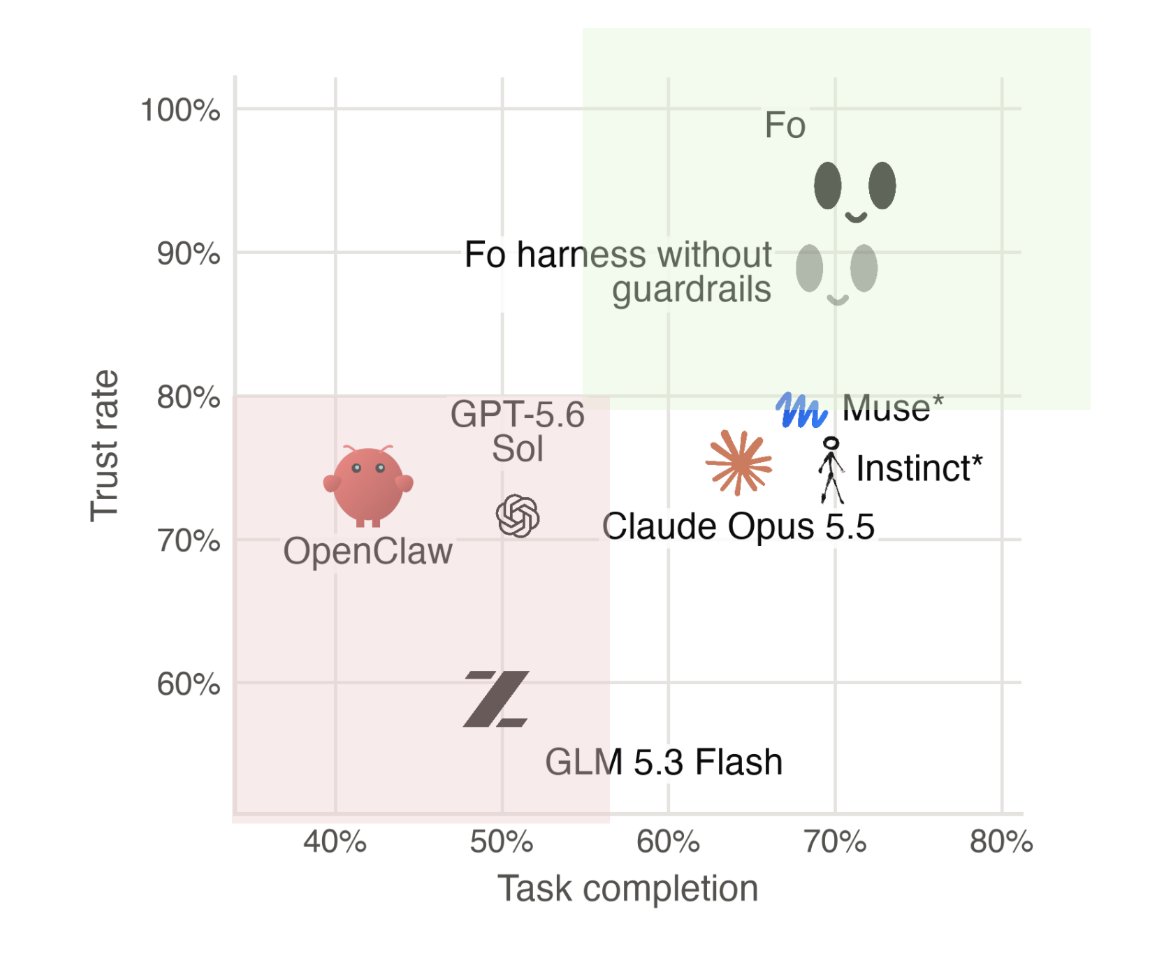
Figure: Official Wajo benchmark evaluation comparing Fo against base models, OpenClaw, and Hermes.
“The biggest barrier to adopting AI personal agents is not intelligence; it is trust. When users know a task will definitively get done without requiring babysitting, their willingness to delegate expands by orders of magnitude.”
Note: While Wajo's initial benchmark showcases compelling completion numbers, industry observers note that these metrics have not yet been independently verified by third-party evaluation groups.
Watch How Fo Works in Action
Curious to see Fo tackling messy, real-world tasks? The team has released demonstrations showcasing the agent handling intricate bookings, rescheduling conflicts, and communicating across platforms.
You can watch how it works in the live demo archive.
In the demo, you can observe how Fo smoothly transitions from automated natural language parsing to execution, quietly routing edge cases to human assistants without bothering the user.
Comparing Approaches: Autonomous Agents vs. Human-Backed AI
How does Wajo's model compare to standard market alternatives?
| Feature | Pure AI Agents (e.g. Traditional Web Agents) | Wajo Fo (Human-Backed AI) |
|---|---|---|
| Task Completion | Fragile on unpredicted web UI changes or CAPTCHAs | High completion via human fallback escalation |
| User Trust | Moderate; user must verify and supervise actions | High; delegate-and-forget reliability |
| Real-World Actions | Restricted to supported APIs and scriptable flows | Spans digital tools, phone calls, and manual portals |
| Learning Flywheel | Relies on synthetic data and prompt adjustments | Trained directly on real human resolution traces |
The Pragmatic Shift in Consumer AI
Shivani Poddar’s background leading critical engineering initiatives at Google DeepMind gives Wajo immense technical credibility. Rather than chasing the theoretical ideal of 100% artificial general intelligence immediately, Wajo represents a distinctly pragmatic philosophy: deliver value today by pairing automated speed with human judgment.
As the AI industry shifts from pure conversational chat to agentic workflows, approaches like Wajo’s Fo demonstrate that the fastest route to reliable digital assistants may not be replacing humans completely, but orchestrating AI and human expertise into a unified, dependable service.
Takeaway:
“The most effective AI agent in the near term may not be the one that acts completely alone, but the one that knows exactly when to ask a human for help.”