AI & Technology
EcoGPT: The AI App Going Viral With an Environmental Promise
Overview: AI Adoption and Growing Environmental Concerns
Artificial intelligence is becoming part of everyday life. People use AI tools to write content, study, search for information, create images, write code, and solve problems. But as AI becomes more popular, concerns about its environmental impact are also increasing.
One AI application has recently attracted attention by connecting AI usage with environmental action: EcoGPT.
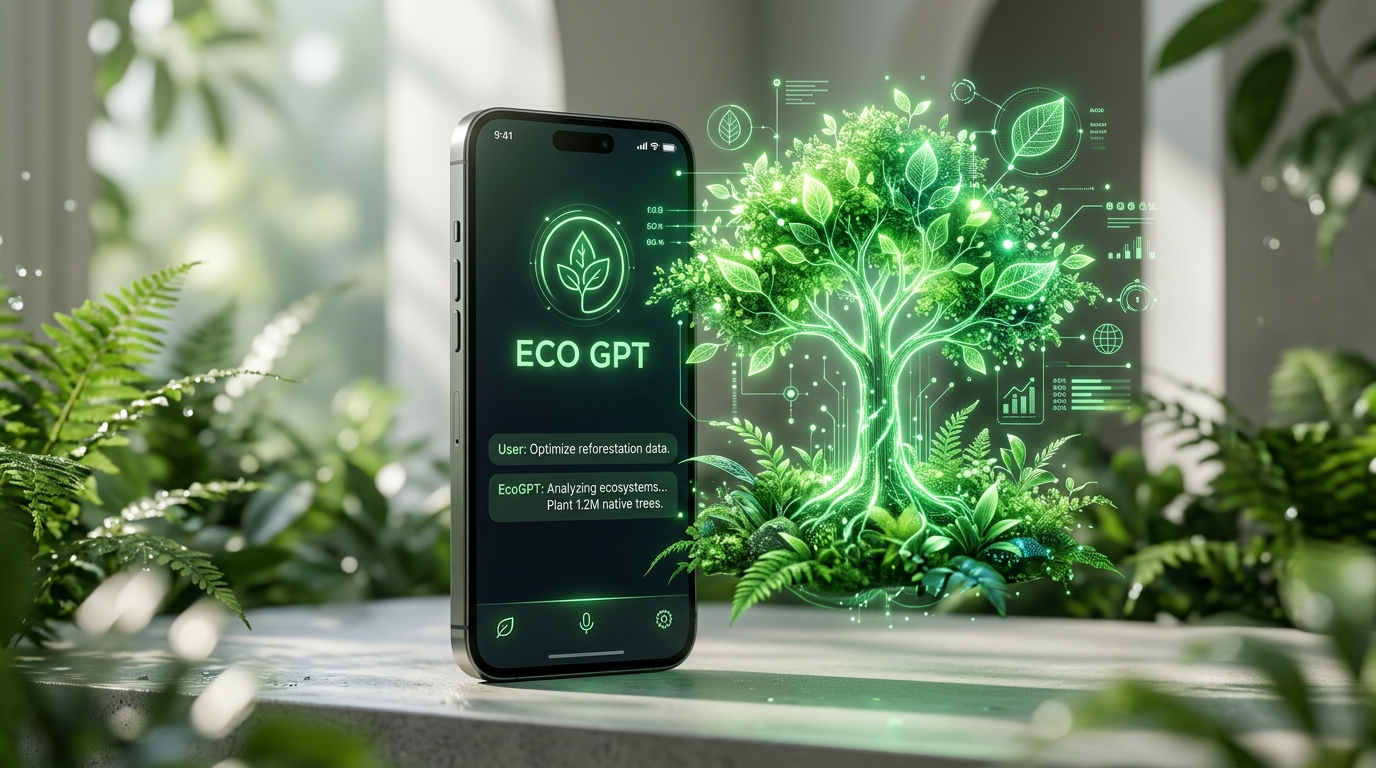
The app has gone viral on social media, with videos claiming that AI data centers consume huge amounts of water and could threaten the world's freshwater supply. At the same time, EcoGPT presents itself as a more environmentally conscious AI assistant, promising to connect user activity with tree-planting efforts.
But what exactly is EcoGPT? Why has it become so popular? And are the environmental claims surrounding it accurate?
Let's take a closer look.
What Is EcoGPT?
EcoGPT is an AI assistant designed to provide many of the features people expect from modern AI applications.
Users can use it for everyday tasks including:
- Writing and editing: Drafting essays, articles, professional messages, and emails.
- Learning and studying: Breaking down complex concepts, coursework, and revisions.
- Research and web searches: Finding information and answering user queries.
- Planning and organization: Creating schedules, routines, and workflows.
- Answering questions: General knowledge, coding troubleshooting, and explanations.
- AI image generation: Creating visuals and creative assets on demand.
- General-purpose conversations: Brainstorming ideas and open dialogue.
The 'Regenerative AI' Positioning & Tree Planting
What makes EcoGPT different is its environmental positioning.
Operated by a Delaware Public Benefit Corporation (PBC), the app markets itself around the idea of "regenerative AI." According to its current disclosures, accumulated user activity contributes toward real tree-planting efforts funded through verified non-profit partners including Trees for the Future, One Tree Planted, and American Forests.
The company states that every 100 messages helps fund the planting of one tree.
In simple terms, EcoGPT is trying to combine two things:
That environmental connection is a major reason the application has attracted viral attention.
When Was EcoGPT Released?
There does not appear to be a clearly documented official launch announcement that establishes one definitive public release date.
However, the application's version history shows that EcoGPT was already receiving updates during spring 2026, with additional releases continuing throughout the year.
By September 2026, the application had become much more visible on social media and had crossed 100,000 downloads on Google Play.
This means EcoGPT was not simply a brand-new application appearing overnight. It had been developing for some time before its recent viral growth.
How Does EcoGPT Work?
From a user's perspective, EcoGPT works much like other AI assistants.
You open the application and enter a question or instruction. For example:
"Explain Python loops for a beginner."The AI generates a response. You could also ask:
"Write a professional email for requesting leave."Or:
"Give me a study plan for learning Python."The application can also provide other AI-related features, depending on the version and subscription available.
The major difference is what happens around the environmental side of the product. EcoGPT says that user activity is connected to environmental initiatives, including tree planting.
According to its current listing, the company uses accumulated chat activity to support tree-planting efforts rather than claiming that every individual message directly plants a tree.
Why Did EcoGPT Go Viral?
The biggest reason behind EcoGPT's rapid growth is social-media marketing.
Short videos began circulating that focused on AI's environmental impact, particularly the amount of water associated with data-center operations.
The basic message was emotionally powerful:
This type of message is extremely effective on social media because it combines technology with a major global concern: climate and environmental protection.
Instead of simply promoting another AI chatbot, EcoGPT became part of a larger conversation: "Can we use AI without damaging the environment?"
That question made the application interesting to people who might otherwise never have heard of it.
Does AI Really Consume Water?
Yes, AI infrastructure can have a water footprint.
Large data centers require significant amounts of electricity and cooling infrastructure. Depending on how a facility is designed and where it operates, water can be involved in cooling systems and in the production of electricity used by the data center.
However, there is an important distinction between saying:
"AI has an environmental impact."
and saying:
"AI will make the planet run out of drinking water."
The first statement is reasonable. The second is an enormous simplification and is not supported simply by the fact that data centers use water.
Water consumption varies considerably depending on the data center, cooling technology, electricity source, location, climate, and many other factors. Therefore, viral claims about AI causing the world's freshwater to disappear should be treated carefully.
Is EcoGPT Really an Environmentally Friendly AI?
This is where things become more complicated.
EcoGPT's environmental model sounds appealing: use an AI assistant and your activity contributes toward planting trees. But being environmentally friendly is not simply about planting trees.
To properly evaluate an AI service's environmental impact, we would need to understand several factors:
- Underlying AI Models: What foundational AI models does it use?
- Compute Infrastructure: Where is its computing infrastructure located?
- Electricity Consumption: How much electricity does it consume?
- Water Footprint: How much water is associated with cooling its infrastructure?
- Tree Selection: How are the trees selected, sourced, and planted?
- Environmental Partners: Which environmental organizations are involved?
- Verification: How is the number of trees independently audited and verified?
- Long-Term Survival: What happens to the trees after they are planted?
Evaluating Claims Beyond Viral Marketing
Without detailed and independently verified information, it is difficult to calculate the application's complete environmental impact.
This doesn't automatically mean that EcoGPT's environmental program is fake.
It means that environmental claims should be evaluated using evidence rather than viral marketing alone.
Why Are People Calling EcoGPT a Scam? (The Greenwashing Debate)
Some users and online communities have started calling EcoGPT a "scam" or accusing it of greenwashing.
However, these terms need to be used carefully.
EcoGPT is a real application available through major app stores. That alone doesn't prove that every marketing claim is accurate, but it does mean that calling the entire application a proven scam would be an overstatement without stronger evidence.
The criticism is primarily focused on the way the environmental message is being presented. Some skeptics argue that the marketing takes a legitimate concern — AI's environmental footprint — and exaggerates it to create fear.
What Is Greenwashing?
Greenwashing happens when a company presents a product or service as more environmentally friendly than the available evidence supports.
For example, imagine a company says:
"Our product saves the planet."That sounds impressive. But consumers should ask: How?
If the company cannot provide clear evidence about its environmental benefits, the claim deserves closer examination.
In EcoGPT's case, the key questions are not simply whether trees are being planted. The bigger question is: Does the environmental benefit meaningfully offset the environmental cost of operating the AI service?
That is much harder to answer.
Is EcoGPT Better Than ChatGPT?
It would be misleading to automatically say that EcoGPT is "better" for the environment than every other AI service.
The environmental footprint of an AI system depends on many factors:
- Model Size: Parameter count and complexity of the model architecture.
- User Volume: Scale of active users and concurrency.
- Data-Center Efficiency: Power Usage Effectiveness (PUE) metrics.
- Cooling Technology: Closed-loop liquid cooling vs. evaporative water consumption.
- Electricity Source: Clean renewable energy vs. fossil fuel grid mix.
- Geographic Location: Ambient climate and local grid carbon intensity.
- Hardware Efficiency: State-of-the-art AI accelerators vs. legacy silicon.
- Implementation of Environmental Program: How rigorously tree planting and conservation are maintained.
Contextual Sustainability: Positioning vs. Verified Data
Simply calling one AI "green" and another AI "bad" doesn't provide the complete picture.
EcoGPT's more interesting distinction is that it builds an environmental initiative into its product positioning.
Whether that makes it genuinely more sustainable requires more transparent data.
Why This Story Matters to the Entire AI Industry
The EcoGPT story highlights a much bigger issue in the AI industry.
AI is growing incredibly quickly, and companies are increasingly being asked to explain the environmental costs of that growth. Data centers require:
And all of these have environmental consequences.
At the same time, people want the benefits of AI without feeling that their everyday AI usage is contributing unnecessarily to environmental problems. That creates an opportunity for companies like EcoGPT.
But it also creates a marketing opportunity. Environmental concerns can generate strong emotional reactions, especially when they are presented through short viral videos. That's why consumers need to separate real environmental problems from exaggerated social-media claims.
Final Verdict: What Should You Think About EcoGPT?
EcoGPT is an interesting example of how AI companies are trying to combine technology with environmental initiatives.
The application provides AI-assistant features while promoting a model in which user activity contributes toward tree planting. Its rapid growth shows how powerful the combination of AI + environmental messaging + social media can be.
However, some of the viral claims surrounding AI's water consumption appear to go much further than the underlying evidence supports.
So, is EcoGPT a scam? There is not enough evidence to make that claim as a proven fact.
Is it worth questioning its environmental marketing? Absolutely.
The best approach is neither to blindly promote EcoGPT nor to dismiss it as a scam without evidence. Instead, ask the important questions:
• How much environmental impact does the AI actually create?
• How much environmental benefit does its tree-planting program provide?
• And can those claims be independently verified?
Those questions are far more useful than simply believing whichever viral video appears in your social-media feed.
The Bigger Picture: The Future of Sustainable AI
EcoGPT may ultimately be remembered not because it created a completely new kind of AI, but because it demonstrated something important about the future of technology marketing:
People don't just want powerful AI anymore. Increasingly, they want to know what that AI costs — financially, socially, and environmentally.
And that conversation is only going to become more important as AI continues to grow.