AI & Technology
Claude Opus 5.5 vs GPT-6 Sol and Luna: The Next Generation of AI Models
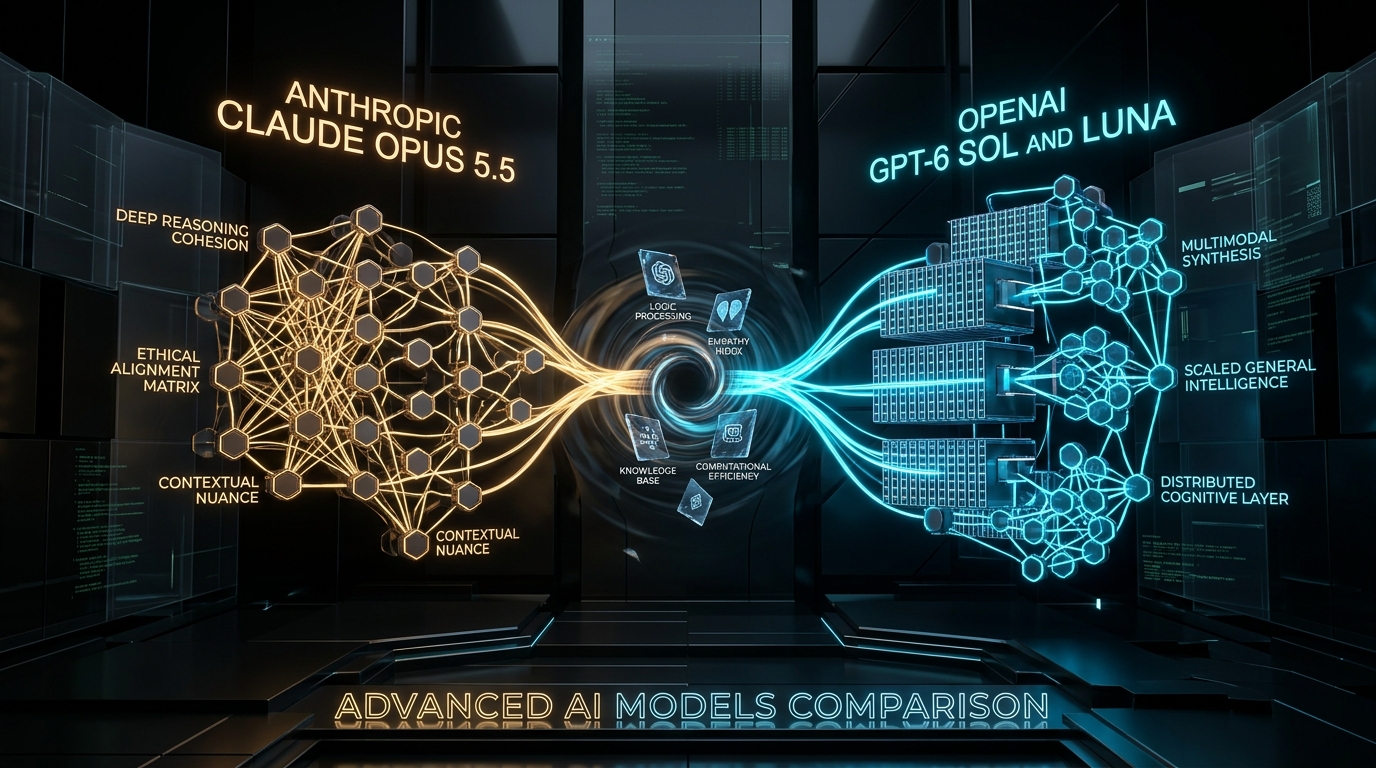
Overview: The Next Generation of AI Models
The AI model race continues to move toward models that are not only more capable, but also faster, cheaper, and better suited to different types of work.
Anthropic has introduced Claude Opus 5.5, its latest high-end Claude model, while OpenAI has expanded its GPT-6 family with GPT-6 Sol and GPT-6 Luna.
Although all three models target different workloads, they share a common goal: delivering stronger AI capabilities while improving efficiency and reducing the cost of using advanced models.
What is Claude Opus 5.5?
Claude Opus 5.5 is Anthropic's latest high-performance model in the Claude family. It is designed for demanding tasks such as advanced coding, complex reasoning, research, and long-running AI agent workflows.
Anthropic also focused on making the model's responses more natural while reducing the cost of running high-end workloads.
The model is positioned as a more efficient successor to the previous Opus generation, with Anthropic stating that it can deliver comparable high-end performance at significantly lower cost.
Release Date and Cloud Availability
Anthropic introduced Claude Opus 5.5 on September 22, 2026.
The model is available through Claude's tools and developer APIs, with availability also extending through major cloud platforms such as AWS Bedrock and Google Cloud Vertex AI.
How Does Claude Opus 5.5 Work?
Like other modern large language models, Opus 5.5 processes a user's instructions and surrounding context, reasons about the requested task, and generates an appropriate response.
For agentic tasks, however, the process can involve multiple steps.
For example, when working with a software repository, an AI coding agent could execute a multi-step loop:
This makes the model useful for tasks that require more than simply answering a question.
What Can You Use Opus 5.5 For?
Some common applications include software development, autonomous agents, and deep research.
For example, instead of asking:
“What is a SQL injection?”
you could give an AI coding agent a repository and ask it to identify possible SQL injection vulnerabilities, trace user input through the application, and explain how the vulnerabilities could be fixed.
- Software Development: Architecting complex features, scaffolding full-stack applications, and implementing nuanced algorithms.
- Debugging & Troubleshooting: Tracing intricate runtime race conditions and edge cases across distributed services.
- Code Review & Refactoring: Enforcing type safety, modular design principles, and modernizing legacy codebases.
- Large Repository Analysis: Ingesting vast monorepos to map architectural dependencies and dead code.
- Autonomous AI Agents: Powering persistent agentic loops capable of multi-hour reasoning and planning.
- Complex Reasoning & Research: Synthesizing dense academic papers, legal contracts, and financial statements.
- Documentation Generation: Producing comprehensive API documentation, architecture decision records, and onboarding guides.
- Computer-Use Workflows: Executing multi-step desktop tasks via direct UI navigation and keyboard/mouse interaction.
Cost and Efficiency: Unlocking Agentic Scale
One of the important changes with Opus 5.5 is efficiency.
Anthropic has positioned the model as significantly cheaper than its previous high-end Opus model, while maintaining strong performance for demanding workloads.
This is particularly important for developers building AI agents because an agent may make dozens or hundreds of model calls during a single task. Lower inference costs directly translate to economically viable agent deployments.
GPT-6 Sol and GPT-6 Luna: OpenAI's Bifurcated Strategy
OpenAI has also expanded its GPT-6 family with two models aimed at different workloads: GPT-6 Sol and GPT-6 Luna.
Rather than using one model for everything, the two models provide different balances between reasoning capability, speed, and cost.
What is GPT-6 Sol?
GPT-6 Sol is designed for more demanding workloads that require advanced reasoning.
The basic idea is simple:
“When a task requires deeper reasoning, Sol is designed for that type of workload.”
For example, a developer could ask Sol to analyze an unfamiliar codebase, understand how multiple services interact, identify a difficult bug, and propose a solution.
- Complex Coding: Solving intricate algorithmic challenges and full-scale architectural refactors.
- Advanced Reasoning: Navigating complex mathematical, scientific, and logical deductions.
- Software Engineering: Managing end-to-end repository maintenance and test suites.
- Agentic Workflows: Orchestrating multi-agent systems and goal-oriented tool interactions.
- Complicated Analysis: Performing deep data forensics, market modeling, and structural evaluations.
- Professional Knowledge Work: Assisting specialized legal, medical, and scientific domain workflows.
What is GPT-6 Luna?
GPT-6 Luna takes a different approach.
It is designed for speed, efficiency, and lower-cost high-volume workloads.
For example, imagine an application that needs to summarize 500,000 customer messages. Using a high-end reasoning model for every message could be unnecessarily expensive.
Luna can be used for the initial processing:
More complicated cases can then be sent to a more capable reasoning model.
- Summarization: Condensing high-volume feeds, chat transcripts, and document batches.
- Classification: Categorizing inbound customer support tickets, emails, and alerts instantly.
- Data Extraction: Parsing unstructured documents, receipts, and forms into strict JSON schemas.
- Simple Chatbots: Providing sub-second conversational latency for standard FAQ and support queries.
- Content Transformation: Reformatting text, translating idioms, and normalizing input schemas.
- Routine Automation: Filtering noise, triaging webhook events, and executing basic scripts.
- High-Volume API Applications: Scaling enterprise pipelines handling millions of daily calls without budget strain.
How Sol and Luna Can Work Together: Model Routing
One interesting approach for developers is model routing.
Instead of sending every request to the most expensive model, an application can decide which model should handle each task.
For example:
A security application could use this architecture:
This approach can help developers balance cost, speed, and reasoning depth.
Claude Opus 5.5 vs GPT-6 Sol vs GPT-6 Luna
The three models are aimed at somewhat different use cases.
| Model | Primary Focus | Typical Use |
|---|---|---|
| Claude Opus 5.5 | High-end reasoning and coding | Complex development and autonomous agents |
| GPT-6 Sol | Advanced reasoning & analysis | Complex coding and professional workflows |
| GPT-6 Luna | Speed, efficiency, & throughput | High-volume processing and routine automation |
This does not mean one model is universally better than the others. Performance depends on the particular task, prompt, tools, context, and application architecture.
How Developers Can Use These Models
Developers can integrate these models across several core architectural tiers:
- 1. AI Chat Applications: Connect models to backend APIs to power intelligent customer support, internal knowledge bases, conversational research assistants, and enterprise productivity copilots.
- 2. Coding Agents: Integrate high-capability models into IDEs and CI/CD pipelines to read codebases, understand architecture, identify issues, write code, run automated tests, and fix errors autonomously.
- 3. AI Security Tools: Combine models with SAST and DAST scanners to inspect Semgrep findings, eliminate false positives, understand root vulnerabilities, and generate verified patches.
Agentic Architectures: Coding and Security Pipelines
In practice, developer workflows leverage closed-loop feedback pipelines.
Autonomous Coding Agent Flow:
Hybrid AI Security Pipeline:
This hybrid setup is particularly valuable because static scanners rapidly highlight potentially unsafe AST patterns, while the LLM reasons across surrounding business logic and runtime context.
Why These Releases Matter: The Shift to Model Routing
The next stage of AI development is not simply about creating larger models.
It is increasingly about using the right model for the right task.
A difficult software-engineering problem may justify using a high-reasoning model such as Opus 5.5 or GPT-6 Sol.
A simple classification or summarization task may not require that level of computation. A faster and cheaper model such as GPT-6 Luna can be more appropriate for those workloads.
This creates a new architecture for production AI applications:
The important shift is therefore from “Which AI model is the biggest?” to “Which model is appropriate for this task?”
As AI models become cheaper and more specialized, this type of model-routing architecture is likely to become increasingly central for production AI systems.
Conclusion: Designing for Capability, Latency, and Cost
Claude Opus 5.5, GPT-6 Sol, and GPT-6 Luna represent different approaches to the same broader trend: making advanced AI more practical for real-world applications.
Claude Opus 5.5 focuses on high-end reasoning, coding, and agentic work while improving efficiency and natural communication.
GPT-6 Sol targets demanding reasoning and professional workloads, while GPT-6 Luna focuses on speed, efficiency, and high-volume tasks.
For developers, the biggest opportunity is not necessarily choosing a single model. It is designing applications that can intelligently route different tasks to the model that fits their requirements for capability, latency, and cost.
Key Takeaway:
“The frontier of AI development is no longer about monolithic brute-force models—it is about intelligent multi-model orchestration balancing reasoning depth, latency, and cost.”