AI & Technology
Apple Enters the John Ternus Era: Why AI Is Becoming the Heart of Apple’s Ecosystem
Overview: A New Chapter Under John Ternus
Apple has entered a new chapter.
On September 1, 2026, John Ternus became Apple's new CEO, succeeding Tim Cook. Just days later, on September 9, Apple held its first major product event under Ternus and introduced a new generation of products and AI-powered experiences.
While new hardware attracted a lot of attention, one thing was especially clear: Apple is putting AI at the center of its product ecosystem.
But what does this actually mean? Is Apple building another chatbot like ChatGPT? Not exactly.
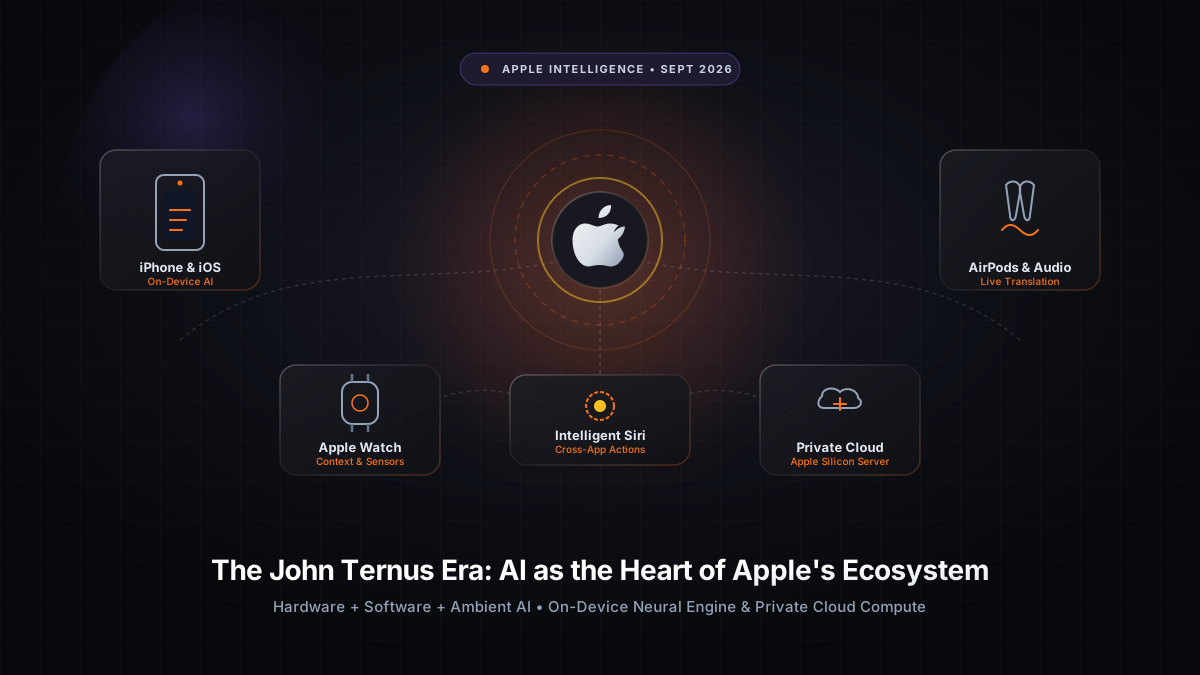
Apple's strategy is much broader: AI is becoming an intelligent layer built into the iPhone, Apple Watch, AirPods, Siri, apps, and the operating system itself.
Who Is John Ternus?
John Ternus is a longtime Apple executive who previously led Apple's Hardware Engineering organization.
He became Apple CEO on September 1, 2026, taking over from Tim Cook.
The phrase “John Ternus era” does not refer to a new Apple technology. It simply describes the new period of Apple's leadership under Ternus.
His background is particularly interesting because he comes from Apple's hardware engineering side. That makes his leadership pivotal as Apple increasingly combines:
What Happened at Apple's September 9 Event?
Apple's September 9, 2026 event was its first major event under John Ternus. The company introduced several new products and ecosystem updates:
- New iPhone Models: Next-generation Apple Silicon optimized for low-latency, on-device Apple Intelligence processing.
- iPhone Duo: Apple's first foldable iPhone, engineered for dual-screen productivity and ambient multitasking.
- New Apple Watch Models: Deeper biometric sensing and contextual proactive intelligence.
- New AirPods: On-device ambient speech translation and audio computational intelligence.
- Next-Gen Siri: Natural language intent resolution, cross-app execution, and personal context awareness.
- Ecosystem-Wide AI Experiences: Native intelligence woven into Mail, Messages, Photos, Notes, and third-party apps.
Ambient Integration: Moving Beyond Hardware
However, the bigger story was not just the hardware. The bigger story was AI integration.
Apple is moving toward a world where AI isn't something you open separately. Instead, AI works quietly in the background of the devices you already use every day.
What Does “Apple’s Renewed AI Focus” Mean?
To understand this shift, compare two fundamentally different paradigms:
Traditional AI Approach:
You open an isolated AI application, prompt it, and wait for a generated answer:
Apple's Integrated AI Approach:
Instead of AI being one application, it becomes a connective layer across the operating system and devices:
That's what Apple means when AI becomes deeply integrated into its product stack.
What Is Apple Intelligence?
Apple Intelligence is Apple's collection of AI capabilities integrated into its devices and software.
Rather than thinking of it as a single AI chatbot, think of it as an AI system that can understand information and help perform tasks across different parts of Apple's ecosystem.
For example, AI can assist with:
- Writing & Communication: System-wide rewriting, proofreading, and tone adjustment across any app.
- Summarization: Instant key points for long email threads, message stacks, and lecture notes.
- Image Understanding: Visual search, semantic cleanup, and photo organization.
- Conversational Siri: Natural language intent recognition with multi-turn conversational memory.
- Real-Time Translation: Frictionless spoken and written translation through AirPods and devices.
- Contextual Search: Locating files, photos, emails, and calendar events based on natural inquiries.
- Personal Assistance: Proactive awareness of personal context to streamline daily tasks.
The Power of Context
The critical concept here is context.
Instead of simply answering a question in isolation, AI can increasingly understand what you're doing on your device, connect the dots across your apps, and help you complete the task with minimal friction.
Dual Architecture: On-Device AI & Private Cloud Compute
Apple's AI strategy mainly revolves around two complementary approaches:
1. On-Device AI
Everyday AI processing happens directly on your Apple device using the Apple Silicon Neural Engine:
This approach provides several core advantages:
• Faster responses: Instant execution without latency from external networks.
• Uncompromised privacy: Data is processed locally without leaving your personal hardware.
• Offline resilience: Core intelligence functions without needing an active internet connection.
• Efficiency: Specialized silicon handles ML workloads with minimal battery drain.
2. Private Cloud Compute
Some AI tasks require more computing power than a single mobile device can provide. In those cases, Apple uses its Private Cloud Compute (PCC) infrastructure:
Apple's goal is to combine cloud computing power with ironclad privacy: your data is never stored, never accessible by Apple, never used to train models, and is cryptographically verifiable by independent security auditors.
AI + Siri: From Voice Commands to Contextual Assistant
One of the biggest areas where AI transforms the Apple experience is Siri.
Traditional voice assistants generally work with predefined command templates (“Set an alarm for 7 AM”). AI-powered assistants go dramatically further by understanding natural language, conversational context, and intent:
• "Find the restaurant my friend mentioned yesterday in Messages."
• "Summarize the important emails I received this morning from the design team."
• "Add the flight times from my brother's email to my calendar."
The long-term goal is to make Siri less like a voice remote and more like an intelligent assistant that understands your intent and acts across your apps.
AI + Photos: Multimodal Search and Understanding
AI can also understand what's inside images through multimodal vision models:
Instead of manually scrolling through thousands of photos, AI can find specific content based on natural descriptions. This multimodal capability allows AI to understand and connect text, images, audio, video, and voice.
AI + AirPods & Apple Watch: Ambient Environmental Intelligence
AirPods and the Apple Watch bring AI off the screen and into your physical environment:
AI + AirPods (Real-Time Translation):
Instead of opening a separate translation app, the translation happens naturally through the devices you are already wearing.
AI + Apple Watch:
Processes voice input, triage notifications, contextual summaries, and biometric indicators on the fly. The Watch evolves from a passive display into a device that understands information and helps you act on it.
"AI is moving from the screen into the environment around us."
Why Is Apple Investing So Heavily in AI?
The AI industry has changed dramatically. Companies like OpenAI, Google, Microsoft, Meta, and Anthropic are rapidly embedding AI into every product.
Apple cannot afford to treat AI as a secondary feature or let users leave its ecosystem for essential daily workflows. The strategy is straightforward:
Don't make users leave the Apple ecosystem to use AI
↓
Bring AI deeply into the ecosystem
AI as a Layer Across Apple's Product Stack
The concept of 'AI as a layer' is simple yet transformative:
AI sits across every experience, connecting context from one device or app to another so users don't have to copy-paste or switch contexts manually.
Everyday Use Cases: Natural Interactions
Users don't need to learn prompt engineering or launch external AI chatbots. AI is woven directly into everyday tasks:
- Writing: "Rewrite this email to be more concise and professional."
- Summarization: "Summarize the unread messages in this group thread."
- Siri & Productivity: "Remind me to finish this proposal when I arrive at the office."
- Photos: "Find all photos with Sarah from our camping trip in Utah."
- Translation: "Translate what the barista is saying in Japanese into English."
Apple vs. Traditional AI: Key Differences
| Feature | Traditional AI Apps | Apple's Integrated Direction |
|---|---|---|
| User Interface | Separate app / browser tab | Integrated into the OS and native apps |
| Workflow | User manually opens & inputs prompt | AI appears seamlessly inside existing workflows |
| Interaction Mode | Mostly text prompts | Text + voice + camera + device sensors + context |
| Infrastructure | Cloud-centric servers | On-device Neural Engine + Private Cloud Compute |
| Product Role | AI as an isolated destination | AI as a foundational platform layer |
| Focus | Chat-based conversation | Task completion and personal workflow assistance |
Why Is This Important for AI Developers?
The AI industry is evolving rapidly past simple chat windows:
Developers need to shift focus from: "How do I create a chatbot?" to: "How can AI understand user context and solve real-world workflows inside apps?"
What Should Developers Learn for the Next Wave of AI?
If you are preparing for a modern AI engineering career, focus on these critical competencies:
- 1. Python & Modern Systems: The foundational language of AI models, APIs, and data engineering.
- 2. LLMs & Small Language Models (SLMs): Understanding model architectures, context windows, token economics, and local on-device inference.
- 3. RAG (Retrieval-Augmented Generation): Connecting models to local and external knowledge bases for accurate, hallucination-free output.
- 4. AI Agents & Tool Calling: Building autonomous reasoning loops that can call APIs, query databases, and execute multi-step logic.
- 5. Multimodal AI: Working with text, images, audio, video, and sensors simultaneously.
- 6. Full-Stack AI Product Engineering: The most valuable skill is combining React, modern backends, vector search, and agents into production-ready software.
What Could Come Next? (The Future of Agentic OS)
The next major milestone is autonomous agentic computing. Imagine saying:
“I'm going to the office tomorrow. Find my meeting details, check the location, remind me when I need to leave, and prepare the documents I need.”
A future AI system performs the entire workflow autonomously:
That is far beyond simply asking ChatGPT a question—it is an AI agent executing a real-world workflow.
Final Thoughts: A Glimpse into the Future of Computing
Apple's new leadership under John Ternus marks an essential inflection point for personal computing.
The biggest change isn't simply a new iPhone or Apple Watch. The bigger change is Apple's drive to make AI a fundamental, invisible part of modern computing.
AI shouldn't always feel like an application you open. It should work naturally across your devices, understand context, protect user privacy, and execute complex workflows on your behalf.
For developers and founders, the takeaway is clear: the future of AI belongs to systems that understand context, leverage tools, and integrate seamlessly into everyday life.